MCQ
How are the field lines in a uniform magnetic field ?
- ACurved.
- BParallel equidistant straight lines.
- CParallel but non-equispaced straight lines.
- DNothing can be said.
Explanation:
A uniform magnetic field is a magnetic field that has the same magnitude and direction throughout the region under consideration, thus the field lines need to be both parallel and spaced out evenly. The density of field lines at a specific point decide the strength of the field at that point, thus a uniform magnetic field or any uniform field for that matter must have the same number of field lines at every point under consideration.
So a uniform magnetic field would look like a bunch of parallel lines spaced out at equal distance from one another.
Generate a complete, print-ready paper with questions like this in minutes — across 16+ boards, with answer keys.
In Young’s experiment, monochromatic light is used to illuminate the two slits A and B. Interference fringes are observed on a screen placed in front of the slits. Now if a thin glass plate is placed normally in the path of the beam coming from the slit

|
(a) The fringes will disappear |
|
(b) The fringe width will increase |
|
(c) The fringe width will increase |
|
(d) There will be no change in the fringe width but the pattern shifts |
A photon of energy 8 eV is incident on a metal surface of threshold frequency 1.6  , then the maximum kinetic energy of photoelectrons emitted is (h = 6.6
|
(a) 4.8 eV |
(a) 4.8 eV |
(c) 1.4 eV |
(d) 0.8 eV |
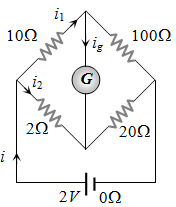
In the circuit shown below the resistance of the galvanometer is 20 W. In which case of the following alternatives are the currents arranged strictly in the decreasing order
|
(a) i, i1, i2, ig |
(b) i, i2, i1, ig |
(c) i, i2, ig, i1 |
(d) i, i1, ig, i2 |
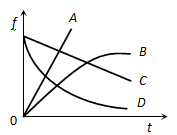
The fraction f of radioactive material that has decayed in time t, varies with time t. The correct variation is given by the curve
|
(a) A |
(b) B |
(c) C |
(d) D |
A short bar magnet placed with its axis at 30° with a uniform external magnetic field of 0.16 Tesla experiences a torque of magnitude 0.032 Joule. The magnetic moment of the bar magnet will be
|
(a) 0.23 Joule/Tesla |
(b) 0.40 Joule/Tesla |
(c) 0.80Joule/Tesla |
(d) Zero |