Question
How did Meselson and Stahl experimentally prove that DNA replication is semiconservative? Explain.
Answer

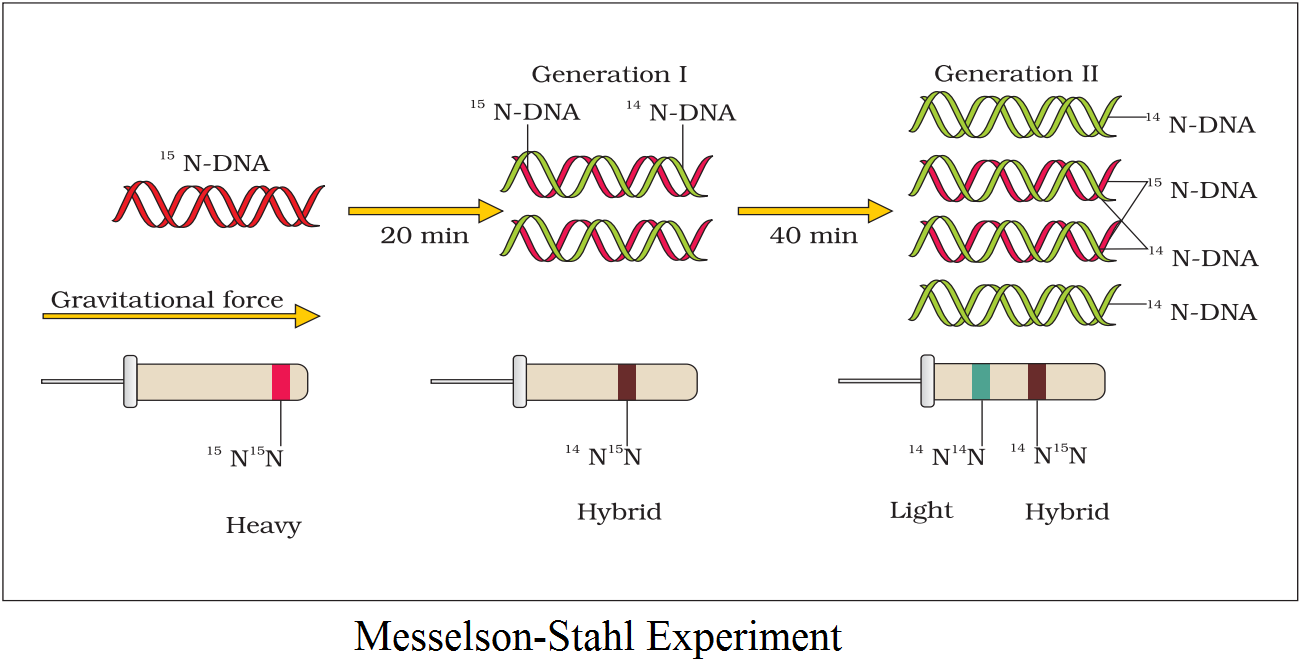
It was to show that DNA replication is semiconservative.
After completion of replication, each new/ daughter molecule of DNA has one parental strand and one newly synthesised strand; this is called semiconservative replication of DNA.
Experiment:

  1. Mathew Meselson and Franklin Stahl performed the experiment.
  2. They grew E.coli, in a medium containing 15NH4CI, until 15N was incorporated in the two strands of newly formed E.coli cells; this 'heavy' DNA can be separated from the normal 14N-DNA by centrifugation in cesium chloride (CsCl) density gradient.
  3. Then they transferred the cells into a medium with normal 14NH4Cl and took out samples at various time intervals.
  4. They extracted the DNA and centrifuged it to measure the densities.
  5. The DNA extracted from cells after one generation after transfer from the 15N medium to 14N medium (i.e. after about 20 minutes), had an intermediate/ hybrid density.
  6. The DNA extracted after two generations (ie. after 40 minutes) consisted of equal amounts of 'light' DNA and 'hybrid' DNA.
  7. This proves that after replication, each DNA molecule has one parental strand and one newly-synthesised strand, i.e. replication is semiconservative.

Need a full question paper?

Generate a complete, print-ready paper with questions like this in minutes — across 16+ boards, with answer keys.
Start Generating Free

Similar questions


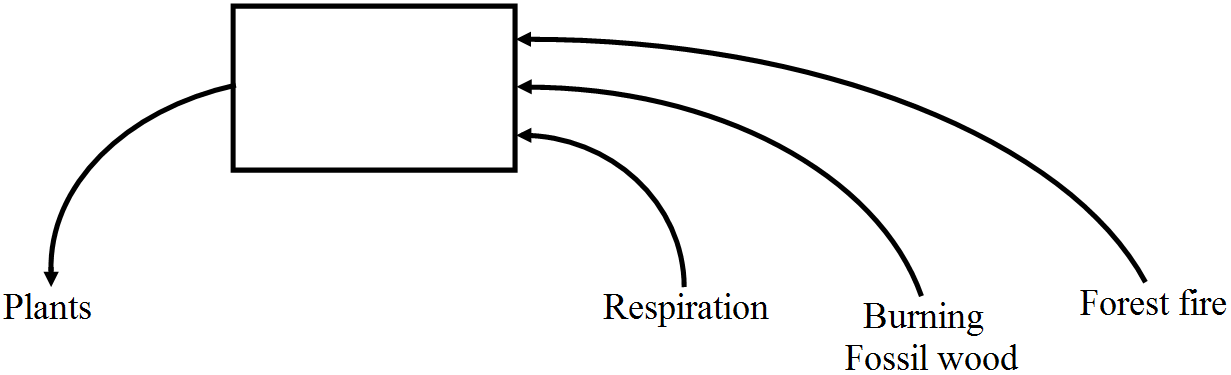
The above diagram shows a simplified biogeochemical cycle.

  1. Name the compound whose cycle is depicted.
  2. In what way do vehicles add this compound to atmosphere?
  3. What adverse effect does its excess have on the environment?
  4. Cite an event which depicts this effect in the modern times.
  5. Suggest two ways of reducing this effect.
Explain the mechanism of evolution.
In the case of snapdragon (Antirrhinum majus) a plant with red flowers was crossed with another plant with white flowers. Trace the inheritance of flower colour up to F2 generation indicating the genotype and phenotype at each level. What special feature do you notice in the genotype and phenotype ratio in F2 generation?
  1. With labelled diagrams, depict the stages in embryo development in a dicotyledonous plant.
  2. Endosperm development precedes embryo development. Why?
Discuss the types of seeds. Also describe its structure.
Explain the efforts for the conservation of biodiversity at international level.
Answer the following questions:
Describe the temperature treatment that enhances the bacteria to take up the rDNA.
We are told that evolution is a continuing phenomenon for all living things. Are humans also evolving? Justify your answer.
Describe the disease 'Typhoid' under the following headings :
(i) Name of the pathogen
(ii) Name of the test to confirm the disease
(iii) Mode of infection
(iv) Four main symptoms of the disease
(v) Diagram of the structure of an antibody molecule.
Give the term/ reason:
Mechanism responsible for parturition.