Question
How do Mendel’s experiments show that traits are inherited independently?

Answer

When Mendel crossed pure-bred tall pea plants with pure-bred dwarf pea plants, he found that only tall pea plants were produced in the F generation. When Mendel further crossed the tall pea plants of the F generation, he found that the tall plants and dwarf plants were obtained in the ratio 3 : 1 in the F generation. Mendel noted that all the pea plants produced in the F generation were either tall or dwarf. There were no plants with intermediate height (or medium height) in-between the tall and dwarf plants. In this way, Mendel’s experiment showed that the traits (like tallness and dwarfness) are inherited independently. This is because if the traits of tallnes and dwarfness had blended (or mixed up), then medium sized pea plants would have been produced.
Need a full question paper?

Generate a complete, print-ready paper with questions like this in minutes — across 16+ boards, with answer keys.

Start Generating Free

Similar questions

Which are the reasons for endangering the species of plants and animals? How can we save those?
When a person puts food in his mouth, then teeth cut it into small pieces, chew and grind it. The glands A in the mouth secrete a substance B which is mixed with the food by tongue. The substance B contains an enzyme C which starts the digestion of food in the mouth. The slightly digested food from the mouth goes down a tube D. The special type of movements E in the walls of tube D push the food into stomach for further digestion. The stomach wall secretes gastric juice containing three substance F, G and H. One of the functions of F is to kill bacteria which may enter the stomach with food. The substance G protects the inside layer of stomach from the damaging effect of substance F whereas substance H is and enzyme for digestion. The partially digested food then enters into small intestine for further digestion.
  1. What is Gland A, Substance B and Enzyme C?
  2. Name the tube D.
  3. What is the movement E known as?
  4. What are F, G and H?
Write the chemical formula of ammonium chloride. Explain why an aqueous solution of ammonium chloride is acidic in nature$?$ Illustrate your answer with the help of a chemical equation.
State whether the following reactions are exothermic or endothermic:
(i) $3 CaO \cdot Al _2 O _{3( s )}+6 H _2 O _{(1)} \rightarrow 3 CaO \cdot Al _2 O _3 \cdot 6 H _2 O _{( s )}+$ Heat
(ii) $2 CaSO _4 \cdot H _2 O +3 H _2 O \rightarrow 2 CaSO _4 \cdot 2 H _2 O +$ Heat
(iii) $KNO _{3( aq )}+ H _2 O _{(0)}+$ Heat $\rightarrow KNO _{3 \text { (aq) }}$
(iv) $NaOH _{( s )}+ H _2 O _{( l )} \rightarrow NaOH _{( aq )}+$ Heat
(v) Transformation of ice into water.
(vi) Water turns into ice.
(vii) Cooking of food.
(viii) Burning candle.


Observe the following figure and write the answer of the question.
Image
  1. Which process is shown in the figure?
  2. Explain the chemical reaction shown in the figure.
  3. Write the reactions on anode and cathode.
Draw the electron-dot structures of the following compounds and state the type of bonding in each case:
  1. $KCl$
  2. $NH_3$
  3. $CaO$
  4. $N_2$
  5. $CaCl_2$
What is myopia or nearsightedness? What are the possible reasons of myopia? How is myopia corrected? Explain with diagrams.
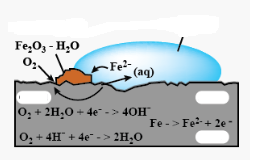
Explain the reaction given in the figure.
Draw a labelled diagram of the human digestive system. With the help of this diagram, describe the process of digestion of food in man (humans).
With the help of a circuit diagram, deduce the equivalent resistance of two resistances connected in series. Two resistances are connected in series as shown in the diagram:
  1. What is the current through the $5$ ohm resistance$?$
  2. What is the current through $R?$
  3. What is the value of $R?$
  4. What is the value of $ V?$