Question
How does a concave lens act as a ‘diverging lens’?
Answer


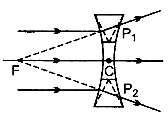
In a concave lens, the upper half of the lens has the bases of the prisms upwards and the lower half of the lens has the bases of the prisms downwards. Therefore in this lens, the rays of light suffer divergence in the upwards direction, and in the lower half, the rays diverge in the downward direction. On being produced backward by dotted lines, these rays appear to diverge from a point F.

Need a full question paper?

Generate a complete, print-ready paper with questions like this in minutes — across 16+ boards, with answer keys.
Start Generating Free

Similar questions

(a)A ray of light is incident at 45° on the face of
(i) A rectangular block of glass.
(ii) A $60^0$ glass prism.
(b) Draw a sketch showing how the ray of monochromatic ray of light passes through glass in each case.
(c) With the aid of a diagram, explain how the face of a right angled prism may totally reflect incident on it.
(d) A thick plane mirror produces several faint images in addition to a prominent one. Draw a ray diagram showing how reflection and refraction produce all these images.
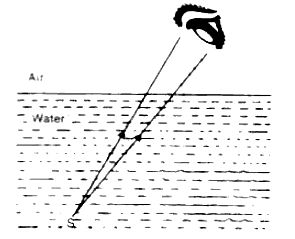
(e) Fig. represents a stone S at the bottom of a pond of water. Using the two rays, as shown, complete the ray diagram to show where the image of the stone appears when viewed from E.

(f) What is a''mirage'? Explain with the help of a diagram.
(g) A man observes the bottom of a swimming pool of $3 \ m$ depth. If the refractive index of water is $1.3,$ what is the apparent depth of water?
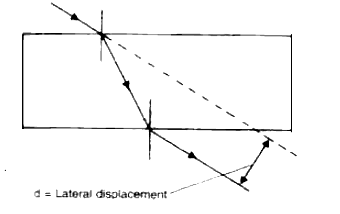
(h) When a ray of light undergoes refraction through a glass slab and when it emerges it is displaced laterally (Fig). What are the factors on which the lateral displacement depends?

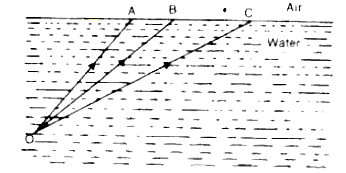
(i) Fig. shows three rays of light $OA, OB$ and $OC$ passing from water to air, making angles $49^0, 41^0$ and $35^0$​​​​​​​ with the horizontal surface respectively. Draw an approximate path of the emergent ray for each. (Critical angle of water is $49^0​​​​​​​$.)
Name the material and type of wires for the following:
(a) Connecting wires for lighting
(b) Fuse wire
(c) Heating elements
(d) Connecting wires of a power line
(e) Earthing elements
Two sets A and B of four bulbs each are glowing in two separate rooms. When one of the bulbs in set A is fused, the other three bulbs also cease to glow. But in set B, when one bulb fuses the other bulbs continue to glow. Explain the difference.
Two copper wires are of the same length, but one is thicker than the other.
  1. Which wire will have more resistance?
  2. Which wire will have more specific resistance?

A ray of monochromatic green light enters a liquid from air, as shown in Fig 4.20. The angle 1 is 45° and angle 2 is 30°.
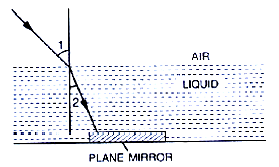
(a) Find the refractive index of liquid.
(b) Show in the diagram the path of the ray after it strikes the mirror and re-enters in air. Mark in the diagram the angles where ever necessary.
(c) Redraw the diagram if plane mirror becomes normal to the refracted ray inside the liquid. State the principal used.

What is an Ohmic resistor?
What is a resistance? Define it with respect to Ohm’s law,
When an arrow is shot from a bow, it has kinetic energy in it. Explain briefly from where does it get its kinetic energy?
How does earthing prevent electrical shock?
What impact will global warming have on the health of the affected population?