Question
How does earthing prevent electrical shock?

Answer

Local earthing provides us safety from electric shocking in the case of short circuiting. When excessive current flows through the live wire, it will pass to the earth through the earth wire. In the absence of local earthing, it may causes fire due to over heating of the live wire.
In the case of an electronic appliance, if its outer metallic body is earthed and by chance, if it happens to touch live wire, then metallic casing acquires the potential of the live wire and so any person touching it is likely to get a total shock. But if earthed, a heavy current flows and the fuse connected to the appliances blows off. Thus the person touching it does not get any shock.
Need a full question paper?

Generate a complete, print-ready paper with questions like this in minutes — across 16+ boards, with answer keys.

Start Generating Free

Similar questions

On what factors does the resistance of a conductor depend?
Steam at 100°C is passed over 1000 g of ice at 0°C. After some time, 600 g of ice at 0°C is left and 450 g of water at 0°C is formed. Calculate the specific latent heat of vaporization of steam (Given: specific heat capacity of water = 4200 J/kg°C, specific latent heat of fusion of ice = 336,000 J/kg.)
Define the term principal foci of a concave lens and show them with the help of proper diagrams.
State two methods of increasing the stability of the body.
A ‘block and tackle’ system used 3 pulleys in the lower block and 4 pulleys in the upper block. What is the ‘velocity ratio’ of this system? If the load is to be lifted by a person capable of applying a maximum effort of 1000 N, what is the maximum load than can be lifted under ideal conditions?
The actual maximum load that gets lifted turns out to be 6300 N. What are the values of the actual M.A. and efficiency of the set-up?
What are the factors that affect the frequency of a vibrating string and how do they affect the frequency?
Trace a ray of light incident at 30° on a surface if travelling from air to glass. What is the angle of refraction in this case? (R.I. for glass = 3/2).
A body of mass m is moving with a uniform velocity u. A force is applied on the body due to
which its velocity changes from u to v. How much work is being done by the force.
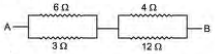
(i) (a) Find the equivalent resistance between A and B .
(b) State whether the resistivity of a wire changes with the change in the thickness of the wire.
(ii) (a) Write down differences between resistance and specific resistance.
(b) What does the slope of a V-I graph for a conductor represent.
(c) A corrent of 0.2 A flows through a conductor of resistance $4.5 \Omega$ Calculate the p.d. at the ends of the conductor.
Image
(iii) (a) Derive an expression for the current (I), when $n$ cells each of emf (E) and the internal resistance ( $r$ ) are connected in series to an external resistance $R$.
(b) State two conditions necessary to have maximum current in the external circuit when the cells are connected in series.
Describe an experiment to demonstrate that there is a magnetic field around a current carrying conductor.