Question
How does nitric acid react with the following ? Give equations.
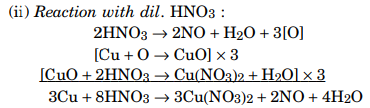
(i) Copper
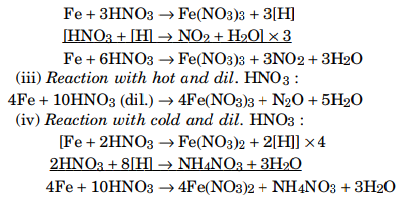
(ii) Iron

Answer

(i) Reaction with hot and conc. $HNO _3$ :
$2 HNO _3 \xrightarrow{\Delta} 2 NO _2+ H _2 O +[ O ]$
$Cu +[ O ] \rightarrow CuO$
Image
Image
Reaction with Iron (Fe) :
(i) Reaction with conc. $HNO _3$ : Iron becomes passive with pure conc. $HNO _3$ i.e. it does not react. As such it becomes due to deposited layer of ferroso ferric-oxide on the surface of iron.
(ii) Reaction with conc. $HNO _3$ :
Image

Need a full question paper?

Generate a complete, print-ready paper with questions like this in minutes — across 16+ boards, with answer keys.
Start Generating Free

Similar questions

  1. State Raoult’s law for a solution containing volatile components.
 How does Raoult’s law become a special case of Henry’s law?
  1. $1.00\ g$ of a non-electrolyte solute dissolved in $50\ g$ of benzene lowered the freezing point of benzene by $0.40 K.$ Find the molar mass of the solute. $(K_f$ for benzene $= 5.12 \ kg\ mol^{-1}).$
Explain valence bond theory for coordination compounds.
(a) Draw the structure of a galvanic cell and also describe the reaction taking place in it.
(b) What happens when opposite external potential is applied in the galvanic cell system? Explain.
Identify $\text\{A, B, C, D, E, R\}$ and $R^1$ in the following:
State the reactions and reaction conditions for the following conversions:
i. Benzene diazonium chloride to nitrobenzene.
ii. Aniline to benzene diazonium chloride.
iii. Ethylamine to methylamine.
The rate constant for the decompositon of N2O5 at various temperatures is given below :
$T /{ }^{\circ} C$020406080
$10^5 \times k / s ^{-1}$0.07871.7025.71782140
Draw a graph between In k and 1/T and calculate the values of A and Ea. Predict the rate constant at $30^{\circ}$ and $50^{\circ}C$.
Cyclobutyl bromide on treatment with magnesium in dry ether forms an organometallic A. The organometallic reacts with ethanol to give an alcohol B after mild acidification. Prolonged treatment of alcohol B with an equivalent of HBr gives 1-bromo-1-methyl cyclopentane $C$. Write the structures of $A, B$ and explain how the $C$ is obtained from B?
Describe the reactions of carboxylic acids in which C-OH bond is broken.
Describe the differences in the properties of lanthanoids and actinoids.
Mention the type of compounds formed when small atoms like H, C and N get trapped inside the crystal lattice of transition metals. Also give physical and chemical characteristics of these compounds.