Question
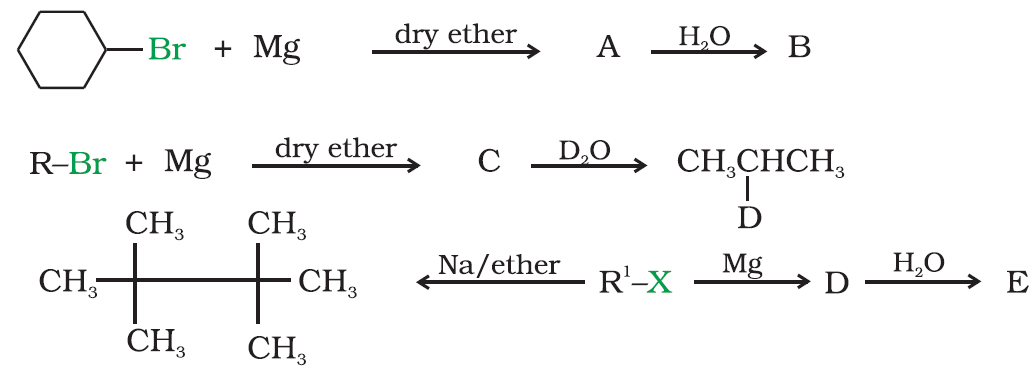
Identify $\text\{A, B, C, D, E, R\}$ and $R^1$ in the following:

Answer


Since $D$ of $D2O$ gets attached to the carbon atom to which $MgBr$ is attached, $C$ is
$\text{CH}_3\text{CHCH}_3\\\ \ \ \ \ \ \ \ \ |\\\ \ \ \ \ \ \ \text{MgBr}\\\text{Isopropylmagnesium bromide}$
Therefore, the compound $R - Br$ is
$\text{CH}_3\text{CHCH}_3\\\ \ \ \ \ \ \ \ \ |\\\ \ \ \ \ \ \ \text{Br}\\2-\text{Bromopropane}$
$\text{CH}_3\text{CHCH}_3+\text{Mg}\xrightarrow[]{\text{dry ether}}\text{CH}_3\text{CHCH}_3\xrightarrow[]{\text{D}_2\text{O}}\text{CH}_3\text{CHCH}_3\\\ \ \ \ \ \ \ \ \ |\ \ \ \ \ \ \ \ \ \ \ \ \ \ \ \ \ \ \ \ \ \ \ \ \ \ \ \ \ \ \ \ \ \ \ \ \ \ \ \ \ \ \ \ \ \ \ |\ \ \ \ \ \ \ \ \ \ \ \ \ \ \ \ \ \ \ \ \ \ \ \ \ \ \ \ \ \ |\\\ \ \ \ \ \ \ \ \text{Br}\ \ \ \ \ \ \ \ \ \ \ \ \ \ \ \ \ \ \ \ \ \ \ \ \ \ \ \ \ \ \ \ \ \ \ \ \ \ \ \ \ \ \text{MgBr}\ \ \ \ \ \ \ \ \ \ \ \ \ \ \ \ \ \ \ \ \ \ \ \text{D}\\\ \ \ \ \ \ \ \ \ \ \ \ \ \ \ \ \ \ \ \ \ \ \ \ \ \ \ \ \ \ \ \ \ \ \ \ \ \ \ \ \ \ \ \ \ \ \ \ \ \ \ \ \ \ \ (\text{C})$
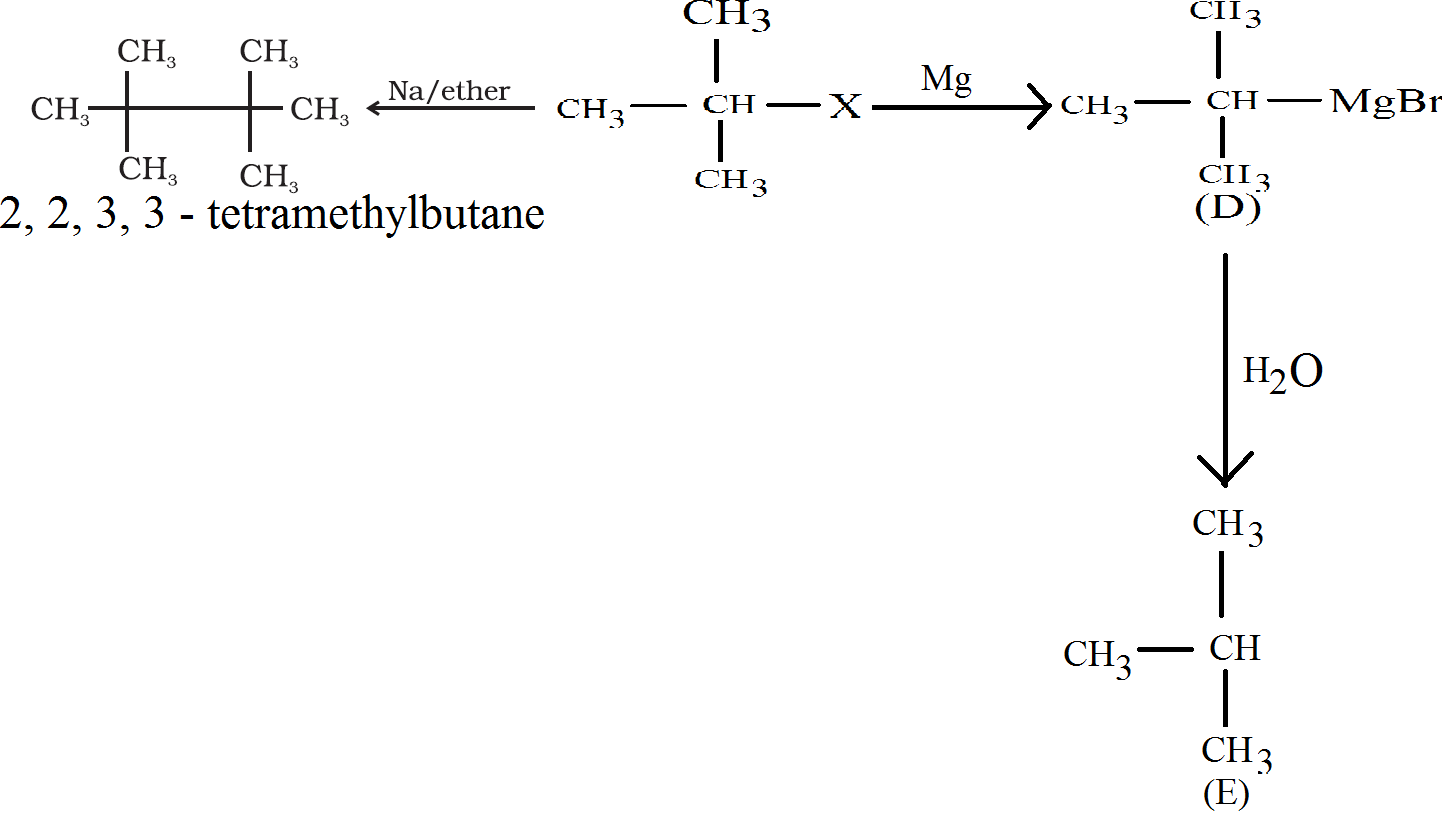
When an alkyl halide is treated with $Na$ in the presence of ether, a hydrocarbon containing double the number of carbon atoms as present in the original halide is obtained as product. This is known as Wurtz reaction. Therefore, the halide, $R1-X,$ is
$\ \ \ \ \ \ \ \ \ \ \ \text{CH}_3\\\ \ \ \ \ \ \ \ \ \ \ \ \ |\\\text{CH}_3-\text{C}-\text{X}\\\ \ \ \ \ \ \ \ \ \ \ \ \ |\\\ \ \ \ \ \ \ \ \ \ \ \text{CH}_3\\\ \text{tert}-\text{Butylhalide}$
Therefore, compound $D$ is
$\ \ \ \ \ \ \ \ \ \ \ \text{CH}_3\\\ \ \ \ \ \ \ \ \ \ \ \ \ |\\\text{CH}_3-\text{C}-\text{MgBr}\\\ \ \ \ \ \ \ \ \ \ \ \ \ |\\\ \ \ \ \ \ \ \ \ \ \ \text{CH}_3\\\ \text{tert}-\text{Butylmagnesiumbromide}$
And, compound $E$ is
$\ \ \ \ \ \ \ \ \ \ \ \text{CH}_3\\\ \ \ \ \ \ \ \ \ \ \ \ \ |\\\text{CH}_3-\text{C}\\\ \ \ \ \ \ \ \ \ \ \ \ \ |\\\ \ \ \ \ \ \ \ \ \ \ \text{CH}_3\\2-\text{Methylpropane}$

Need a full question paper?

Generate a complete, print-ready paper with questions like this in minutes — across 16+ boards, with answer keys.

Start Generating Free

Similar questions

  1. A $10\%$ solution $($by mass$)$ of sucrose in water has a freezing point of $269.15 K$. Calculate the freezing point of $10\%$ glucose in water if the freezing point of pure water is $273.15 K.$ Given:
$($Molar mass of sucrose $= 342\ g\ mol^{-1})$
$($Molar mass of glucose $= 180\ g\ mol^{-1})$
  1. Define the following terms:
  1. Molality $(m)$
  2. Abnormal molar mass
Write IUPAC names of the following compounds and classify them into primary, secondary and tertiary amines.
1. $\left( CH _3\right)_2 CHNH _2$
2. $CH _3\left( CH _2\right)_2 NH _2$
3. $CH _3 NHCH \left( CH _3\right)_2$
4. $\left( CH _3\right)_3 CNH _2$
5. $C _6 H _5 NHCH _3$
Explain the relationship between basicity and structure of amines.
Answer the following question:
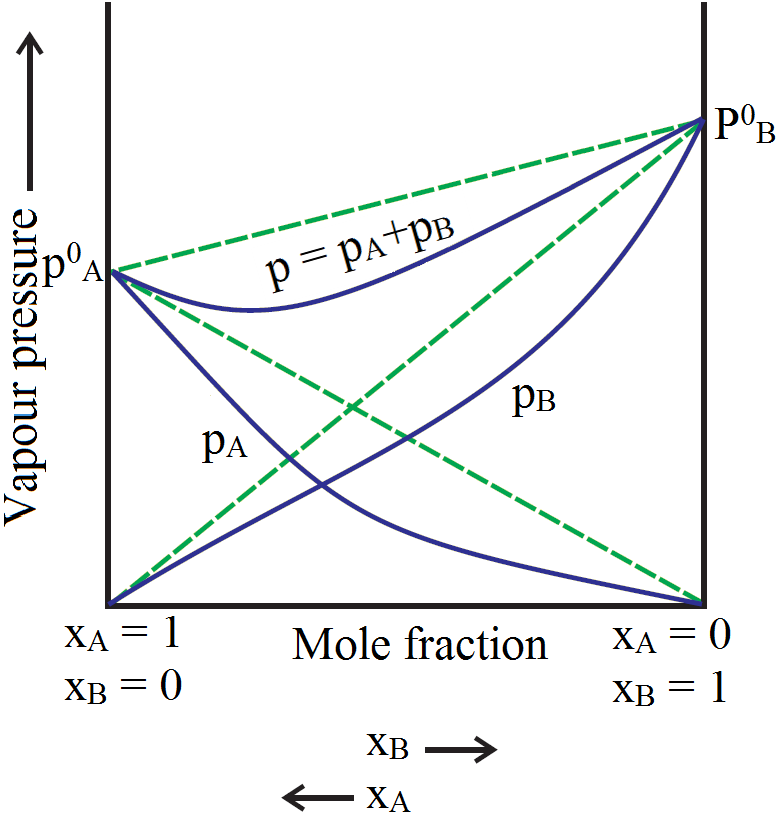
The graphical representation of vapour pressures of two component system as a function of composition is given alongside. By graphic inspection, answer the following questions:
  1. Are the A-B interactions weaker, stronger or of the same magnitude as A-A and B-B?
  2. Name the type of deviation shown by this system from Raoult’s law.
  3. Predict the sign of $\Delta_\text{mix}\text{H}$ for this system.
  4. Predict the sign of $\Delta_\text{mix}\text{H}$ for this system.
  5. Give an example of such a system.
  6. What type of azeotrope will this system form, if possible?
Write down the IUPAC name for each of the following complexes and indicate the oxidation state, electronic configuration, and coordination number. Also, give stereochemistry and magnetic moment of the complex:
a. $\left.K \left[ Cr \left( H _2 O \right)_2\right\}\left( C _2 O _4\right)_2\right] \cdot 3 H _2 O$
b. $\left[ Co \left( NH _3\right)_5 Cl \right] Cl _2$
c. $CrCl _3( py )_3$
d. $Cs \left[ FeCl _4\right]$
e. $K _4\left[ Mn ( CN )_6\right]$
What happens when:
(a) Propene is passed into concentrated $H _2 SO _4$ and the product is boiled with water.
(b) Methoxy ethane is heated with HI.
(c) Ethanol is heated with Fenton's reagnet.
(d) Toluene is heated with Chromyl Chloride in $CS _2$ and the product is hydrolysed.
(e) Crotonaldehyde is treated with $LiAH _4 / dry$ ether and the product is acid hydrolysed.
For the decomposition of azoisopropane to hexane and nitrogen at 543 K , the following data is obtained :
$t( sec )$$P$ (mm of Hg )
035.0
36054.0
72063.0

Calculate the rate constant.
What is crystal field theory? On the basis of this, explain the crystal field splitting in octahedral coordinaton compounds.
$19.5 g$ of $\ce{CH2FCOOH}$ is dissolved in $500 g$ of water. The depression in the freezing point of water observed is $1.0^\circ C$. Calculate the van’t Hoff factor and dissociation constant of fluoroacetic acid.