MCQ
How does retarding potential vary with the frequency of light causing photoelectric effect?
  • A
    Infinite
  • B
    Zero
  • C
    Decreases
  • Increases

Answer

Correct option: D.
Increases

The stopping potential is directly proportional to the frequency of light.
Hence, the stopping potential increases with an increase in the frequency of the incident light.

Need a full question paper?

Generate a complete, print-ready paper with questions like this in minutes — across 16+ boards, with answer keys.
Start Generating Free

Similar questions

Two identical balls having like charges and placed at a certain distance apart repel each other with a certain force. They are brought in contact and then moved apart to a distance equal to half their initial separation. The force of repulsion between them increases $4.5$ times in comparison with the initial value. The ratio of the initial charges of the balls is
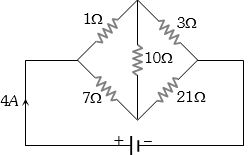
In the circuit shown in figure, the current drawn from the battery is $4\,A$. If $10 \,\Omega$ resistor is replaced by $20\,\Omega$ resistor, then current drawn from the circuit will be .............. $A$
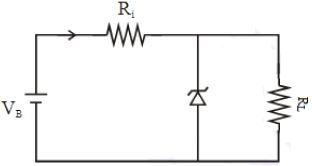
The figure represents a voltage regulator circuit using a Zener diode. The breakdown voltage of the Zener diode is $6\,V$ and the load resistance is $R_L= 4\,k\Omega .$ The series resistance of the circuit is $R_i = 1\,k\Omega .$ If the battery voltage $V_B$ varies from $8\,V$ to $16\,V,$ what are the minimum and maximum values of the current through Zener diode?
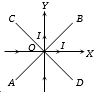
Two very thin metallic wires placed along $X$ and $Y$-axis carry equal currents as shown here. $AB$ and $CD$ are lines at $45^\circ $ with the axes with origin of axes at $O$. The magnetic field will be zero on the line
A cell is connected between two points of a uniformly thick circular conductor. The magnetic field at the centre of the loop will be
An electric dipole is placed at an angle $60^{\circ}$ with an electric field of strength $4 \times 10^5 \,N / C$. It experiences a torque equal to $8 \sqrt{3} \,Nm$. Calculate the charge on the dipole, if dipole is of length $4 \,cm$ is ......... $C$
An expression for rate of heat generated, if a current of $I$ ampere flows through a resistance of $R$ $\Omega$, is
Characteristic curve of ideal $p-n$ diode is
The typical ionisation energy of a donor in silicon is
Three positive charges of equal value $q$ are placed at the vertices of an equilateral triangle. The resulting lines of force should be sketched as in