Question
  1. How is artificial hybridisation considered a crop improvement programme?
  2. Explain the process of artificial hybridisation, if
  1. Female parent bears bisexual flowers.
  2. Female parent bears unisexual flowers.

Answer

  1. Artificial hybridisation involves crossing of different varieties or species or even different genera to combine the desirable characters of the two parents to produce a commercially superior variety.
  2.  
  1. When the female parent bears bisexual flowers:
  • Emasculation is necessary; it is the removal of anthers/ stamens before the pollen grains mature.
  • The emasculated flower is bagged to prevent contamination of the stigma with unwanted pollen grains.
  • When the stigma attains receptivity, the pollen grains collected from the selected male parent are dusted on the stigma.
  • The flower is rebagged and allowed for further development.
  1. When the female parent bears unisexual flowers:
  • There is no need for emasculation.
  • The female flower is bagged before the stigma becomes receptive.
  • When the stigma becomes receptive, the pollen grains collected from the selected male parent are dusted on the stigma.
  • The flower is rebagged and allowed for further development.

Need a full question paper?

Generate a complete, print-ready paper with questions like this in minutes — across 16+ boards, with answer keys.
Start Generating Free

Similar questions

Explain with the help of one example how genetically modified plants can:
  1. Reduce usage of chemical pesticides.
  2. Enhance nutritional value of food crops.
Differentiate between microsporogenesis and megasporogenesis. Which type of cell division occurs during these events? Name the structures formed at the end of these two events.
Draw a labelled diagram of the sectional view of a mature pollen grain in angiosperms. Explain the functions of its different parts.
(a) Write the name of primates existing on earth about 15 million years ago. Write its important characteristics also?
(b) (i) From where did the animals similar to human being meet?
(ii) In which sequence were neanderthal, homohabilis and homo erectus evolved on earth?
(iii) When did modern man evolve on this planet?
  1. A primary succession start on a bare rock and reach a climax community
A. Cryptorchidism is a condition in which the testes fail to descend into the scrotum. It can also lead to compromised Sertoli cell function and has an impact on Leydig cell function.
(i) Identify at least 3 parameters of male fertility which get affected due to cryptorchidism.
(ii) Which process will be affected if mature spermatids are not released from Sertoli cells?
(iii) Name and explain one assisted reproductive technology (ART process) in which the sperm/semen is used to assist fertilization.
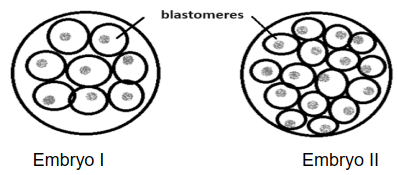
(iv) Name and explain the assisted reproductive technology that should be used to complete the development of embryos I and II shown in the figure given below.
What is malaria ? Write down reason, symptoms, prevention and treatment.###Write about the malaria fever, its causes, symp-toms, control and prevention.###Name the different species of plasmodium which species is responsible for malignant malaria?
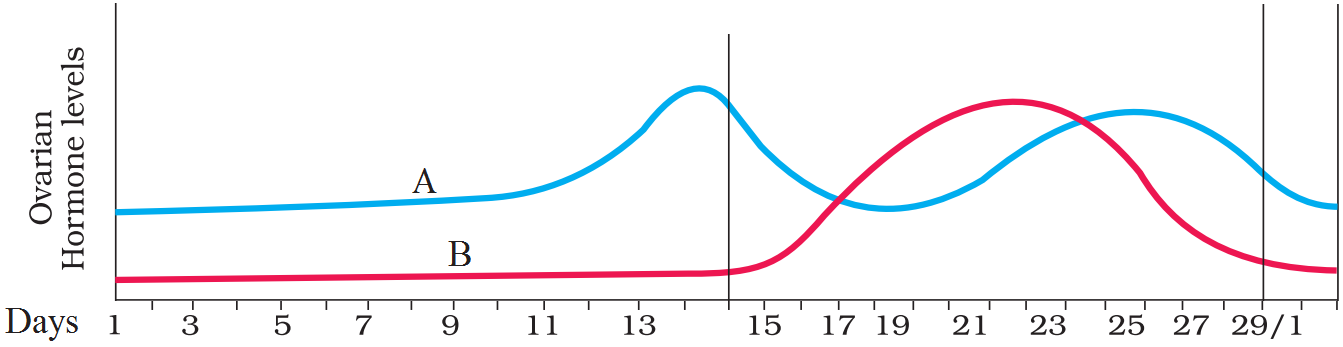
The graph given below shows the variation in the levels of ovarian hormones during various phases of menstrual cycle:

Specify the source of the hormone marked in the diagram.

Differentiate between homology and analogy. Also discuss the homologous and vestigeal organs with example and how do they explain the evidence of evolution.
The following table shows certain diseases, their causative organisms and symptoms. Fill the gaps.
  Name of the Disease Causative organism Symptoms
i. Ascariasis Ascaris ________
ii. ________ Trichophyton Appearance of dry, scaly lesions on various parts of the body.
iii. Typhoid ________ High fever, weakness, headache, stomach pain, constipation.
iv. Pneumonia Streptococcus pneumoniae ________
v. ________ Rhino viruses Nasal congestion and discharge, sorethroat, cough, headache.
vi. Filariasis ________ Inflammation in lower limbs.