Question
How is global poverty a source of insecurity? Explain.

Answer

  • High per capita income and low population growth make rich groups get richer, where as low incomes and high population growth make poor groups get poorer.
  • Poverty also led to large scale migration to seek a better life.
  • It can create armed conflicts.
  • It caused population growth mainly in South Asian poor countries.

Need a full question paper?

Generate a complete, print-ready paper with questions like this in minutes — across 16+ boards, with answer keys.
Start Generating Free

Similar questions

'States have common but differentiated responsibilities towards environment.' Analyses the statement giving suitable Examples.

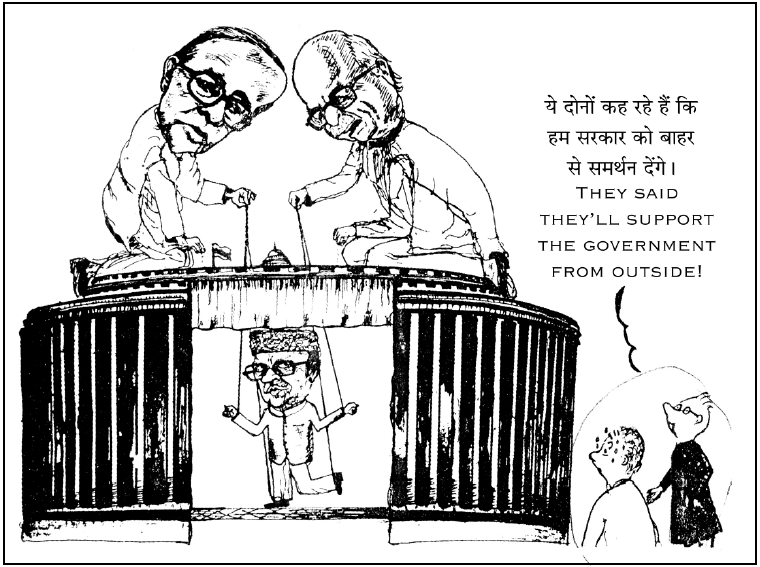
Study the above cartoon carefully and answer the following questions:
  1. Who was head of the Government formed by the National Front in 1989?
  2. Why was the government formed by him called a puppet government?
  3. Identify the puppeteers pulling the strings and the political parties they belong to.
Explain any four reasons for the dominance of the Congress Party in the first three General Elections.
Read the passage given below carefully and answer the following questions:
The interim government took a firm stance against the possible division of India into smaller principalities of different sizes. The Muslim League opposed the Indian National Congress and took the view that the States should be free to adopt any course they liked. Sardar Patel, India's Deputy Prime Minister and the Home Minister during the crucial period, immediately after Independence, played a historic role in negotiating with the rulers of Princely States in bringing most of them into the Indian Union.
  1. Which government has been referred to as the interim government?
  2. Why did the Muslim League oppose the Indian National Congress?
  3. What makes the role of Sardar Patel a historic one? Explain.
Study the following passage carefully and answer the questions based on it that follow:
Sardar Sarovar Project is a multipurpose mega-scale dam. Its advocates say that it would benefit huge areas of Gujarat and the three adjoining states in terms of availability of drinking water and water for irrigation, generation of electricity and increase in agricultural production. Many more subsidiary benefits like effective flood and drought control in the region were linked to the success of this dam. In the process of construction of the dam 245 villages from these states were expected to get submerged. It required relocation of around two and a half lakh people from these villages. Issues of relocation and proper rehabilitation of the project-affected people were first raised by local activist groups.
  1. What form of agitation did the protests against the dam take?
  2. Why have benefits like flood and drought control been called as subsidiary benefits?
  3. Since 245 villages were expected to get submerged, how far is the construction of the dams justified?
Describe various aspects of human security as well as global security.
Analyse the circumstances that led to the restoration of Congress System after the Party’s split in 1969.
Describe any two important components of India's security strategy.
Read the passage given below carefully and answer the following questions:
The Congress evolved from its origins in 1885 as a pressure group for the newly educated, professionals and commercial classes to a mass movement in the twentieth century. This laid the basis for its eventual transformation into a mass political party and its subsequent domination of the political system. Thus the Congress began as a party dominated by the English speaking, upper caste, upper middle class and urban elite. But with every Civil Disobedience Movement it launched, its social base widened.
  1. What is meant by a pressure group?
  2. Explain the reason for the Congress to be transformed into a rainbow-like social coalition by the time of Independence.
  3. What made the Congress into a mass political party in the twentieth century?
Answer the following questions based upon the following Press Report:
‘Bharatiya Kisan Union wants agriculture out of WTO purview’
By our Staff Correspondent
Mysore, Feb. 15
The Bharatiya Kisan Union has warned of socio-economic upheavals in the country if India does not bargain to keep agriculture out of the purview of the World Trade Organisation.
Addressing a press conference here today, the Chief of the Union, Mahender Singh Tikait and its National’ Coordinating Committee Convener, M. Yudhveer Singh warned of impending dangers if India goes ahead and agrees to the stipulations of the WTO in the next round of meetings scheduled to be held in Hong Kong in November.
Courtesy: The Hindu, February 16, 2005
  1. What is BKU?
  2. Why is it against the WTO?
  3. What dangers are anticipated for Indian agriculture from the WTO?