MCQ
How many bonds (bond order) does $B_2$ have ?
- A$0$
- ✓$1$
- C$2$
- D$3$
The atomic number of boron is $5$ , for which the electronic configuration of boron can be given as: $1 s^2\, 2 s^2\, 2 p^1$
The molecular orbital diagram for $B _2$ molecule can be shown as:
From the diagram, we can know that the number of electrons in bonding molecular orbitals is $4$ whereas the number of electrons in antibonding molecular orbitals is $2.$
Hence, the bond order is calculated as:
Bond order $=\frac{1}{2}(4-2)$
$=1$
Generate a complete, print-ready paper with questions like this in minutes — across 16+ boards, with answer keys.
Upon treatment with dilute alkaline $KMnO _4, P$ as well as $Q$ could produce one or more than one from $S , T$ and $U$.$Image$
$1.$ Compounds formed form $P$ and $Q$ are, respectively
$(A)$ Optically active $S$ and optically active pair $(T, U)$
$(B)$ Optically inactive $S$ and optically inactive pair $(T, U)$
$(C)$ Optically active pair $(T, U)$ and optically active $S$
$(D)$ Optically inactive pair $(T, U)$ and optically inactive $S$
$2.$ In the following reaction sequences $V$ and $W$ are respectively :$Image$
mcq $Image$
Give the answer question $1$ and $2.$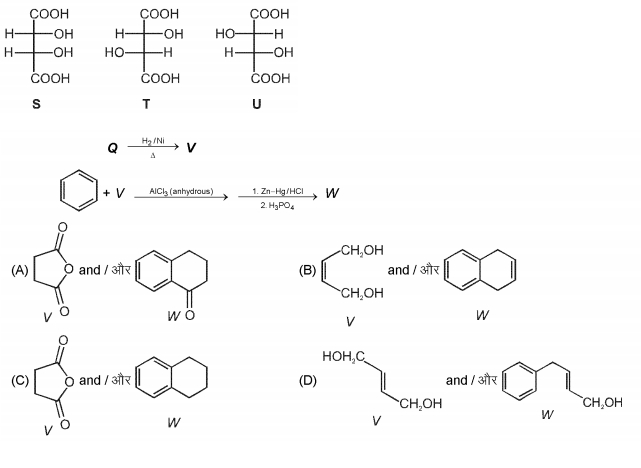
$(I)$ It is easier to remove $2 \mathrm{p}$ electron than $2 \mathrm{s}$ electron
$(II)$ $2 \mathrm{p}$ electron of $\mathrm{B}$ is more shielded from the nucleus by the inner core of electrons than the $2 s$ electrons of $Be.$
$(III)\; 2 s$ electron has more penetration power than $2 \mathrm{p}$ electron.
$(IV)$ atomic radius of $\mathrm{B}$ is more than $\mathrm{Be}$
(Atomic number $\mathrm{B}=5, \mathrm{Be}=4$ )
The correct statements are
$S_8,\,S_2O_3^{2-},\, S_2O_7^{-2},\, S_4O_6^{-2},\, SO_3^{-2}$
$PCl_5(g) \rightleftharpoons PCl_3(g) + Cl_2(g)$
If total pressure at equilibrium of the reaction mixture is $P$ and degree of dissociation of $PCl_5$ is $x,$ the partial pressure of $PCl_3$ will be