MCQ
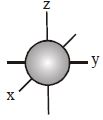
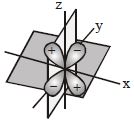
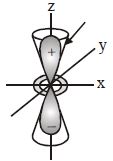
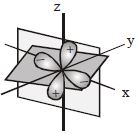
Which of the following orbitals represents $3d_{z^2}$ orbitals ?
  • A

  • B


  • D

Answer

Correct option: C.

c

Need a full question paper?

Generate a complete, print-ready paper with questions like this in minutes — across 16+ boards, with answer keys.

Start Generating Free

Similar questions

Which statement is incorrect
Among the xylenes, which is thermodynamically most stable?
The outer orbitals of $C$ in ethene molecule can be considered to be hybridized to give three equivalent $sp^2$ orbitals. The total number of sigma $(\sigma )$ and pi $(\pi )$ bonds in ethene molecule is
Rearrange the following ( $I$ to $IV$ ) in the order of increasing masses
$(I)\,0.5$ mole of $O_3$
$(II)\,0.5\,gm$ atoms of oxygen
$(III)\,3.011 \times 10^{23}$ molecules of $O_2$
$(IV)\,5.6$ litre of $CO_2$ at $STP$
Which of the following is correct for $2p-$ orbitals ?
Radius of $1^{\text {st }}$ orbit of $H$ and some orbit of $Be ^{3+}$ is same . Energy of their orbit of $Be ^{3+}$ is ............$eV$
One mole of ${N_2}{H_4}$ loses $10\, mol$ of electrons to form a new compound $Y$. Assuming that all nitrogen appear in the new compound, what is the oxidation state of ${N_2}$ in $Y$ ? (There is no change in the oxidation state of hydrogen)
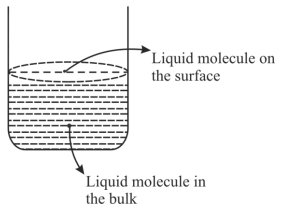
Based on the given figure, the number of correct statement/s is/are $........$.

$A.$ Surface tension is the outcome of equal attractive and repulsion forces acting on the liquid molecule in bulk.

$B.$ Surface tension is due to uneven forces acting on the molecules present on the surface.

$C.$ The molecule in the bulk can never come to the liquid surface.

$D.$ The molecules on the surface are responsible for vapour pressure if the system is a closed system.
Calculate $(q)$ when $0.75$ mole of an ideal gas expands isothermally and reversibly at $27\,^oC$ from a volume of $15$ litre to $25$ litre 

(Given $\log 5 = 0.70, \log 3 = 0.48$)

...... $joule$

Which of the following is not a peroxide