MCQ
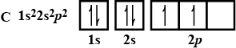
How many of unpaired electron in carbon atom is :
- ✓$2$
- B$4$
- C$1$
- D$4$
Generate a complete, print-ready paper with questions like this in minutes — across 16+ boards, with answer keys.
$\Psi_{2 s}=\frac{1}{2 \sqrt{2 \pi}}\left(\frac{1}{a_0}\right)^{1 / 2}\left(2-\frac{ r }{ a _0}\right) e ^{- r / 2 a _0}$
At $r=r_0$, radial node is formed. Thus, $r_0$ in terms of $a_0$
$2 \mathrm{~K}_{2} \mathrm{Cr}_{2} \mathrm{O}_{7}+8 \mathrm{H}_{2} \mathrm{SO}_{4}+3 \mathrm{C}_{2} \mathrm{H}_{6} \mathrm{O} \rightarrow 2 \mathrm{Cr}_{2}\left(\mathrm{SO}_{4}\right)_{3}+$
$3 \mathrm{C}_{2} \mathrm{H}_{4} \mathrm{O}_{2}+2 \mathrm{~K}_{2} \mathrm{SO}_{4}+11 \mathrm{H}_{2} \mathrm{O}$
If the rate of appearance of $\mathrm{Cr}_{2}\left(\mathrm{SO}_{4}\right)_{3}$ is $2.67 \,\mathrm{~mol}$ $\min ^{-1}$ at a particular time, the rate of disappearance of $\mathrm{C}_{2} \mathrm{H}_{6} \mathrm{O}$ at the same time is ...... $\mathrm{mol}\, \mathrm{min}^{-1}$ (Nearest integer)
The time taken for $A$ to become $1 / 4^{\text {th }}$ of its inital concentration is twice the time taken to become $1 / 2$ of the same. Also, when the change of concentration of $B$ is plotted against time, the resulting graph gives a straight line with a negative slope and a positive intercept on the concentration axis. The overall order of the reaction is . . . . .