MCQ
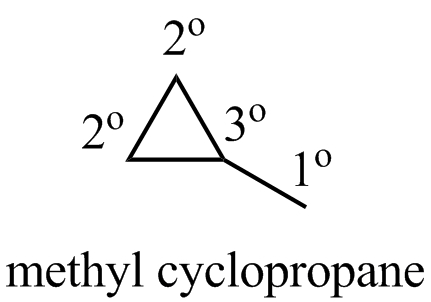
How many secondary carbon atoms does methyl cyclopropane have ?
  • A
    None
  • B
    $1$
  • $2$
  • D
    $3$

Answer

Correct option: C.
$2$
c
Methyl cyclopropane has two secondary carbon atoms, one primary carbon atom and one tertiary carbon atom.

A primary carbon atom is attached to only one other carbon atom.

A secondary carbon atom is attached to two other carbon atoms.

A tertiary carbon atom is attached to three other carbon atoms

A quaternary carbon atom is attached to four other carbon atoms.
Need a full question paper?

Generate a complete, print-ready paper with questions like this in minutes — across 16+ boards, with answer keys.

Start Generating Free

Similar questions

According to $VSEPR$ theory, in which species do all the atoms lie in the same  plane? 

                           $1. CH^+_3$            $2. \,CH^-_3$

Which of the following ion is diamagnetic 
Oxidation state of $+ 1$ for phosphorus is found in
How many gram of cobalt metal will be deposited when a solution of cobalt $(II)$ chloride is electrolyzed with a current of $10$ amperes for $109$ minutes $(1$ Faraday $= 96,500\, C;$ Atomic mass of  $Co = 59\, u)$
Energy levels $A, B, C$ of a certain atom corresponds to increasing values of energy, $i.e.,$ $E_A < E_B < E_C .$ If $\lambda _1, \lambda _2$ and $\lambda _3$ are the wavelength of radiations corresponding to the transitions $C$ to $B, B$ to $A$ and $C$ to $A$ respectively, which of the following statement is correct :
The reagent which does not give acid chloride on treating with a carboxylic acid is
The acid that results when a base accepts a proton is called
Which of the following statement is correct regarding $H_2S_4O_6$ ?
The energies $E_1$ and $E_2$ of two radiations are $25\ eV$ and $50\ eV$ respectively. The relation between their wavelengths i.e., $\lambda _1$ and $\lambda _2$ will be
A solution of m-chloroaniline, $m-$chlorophenol and $\mathrm{m}$ -chlorobenzoic acid in ethyl acetate was extracted initially with a saturated solution of $\mathrm{NaHCO}_{3}$ to give fraction $\mathrm{A}$. The left over organic phase was extracted with dilute $NaOH$ solution to give fraction $\mathrm{B}$. The final organic layer was labelled as fraction $\mathrm{C}$. Fractions $\mathrm{A},\mathrm{B}$ and $\mathrm{C},$ contain respectively