MCQ
How much work does a pulling force of $40 \,N$ do on the $20\, kg$ box in pulling it $8 \,m $ across the floor at a constant speed. The pulling force is directed at $60^o $ above the horizontal.....$J$
  • $160 $
  • B
    $277$
  • C
    $784 $
  • D
    None of the above

Answer

Correct option: A.
$160 $
a
(a) $W = \vec F.\vec s = 40 \times 8 \times \cos 60^\circ = 160\,J$

Need a full question paper?

Generate a complete, print-ready paper with questions like this in minutes — across 16+ boards, with answer keys.

Start Generating Free

Similar questions

A circular disc of radius $R$ and thickness $\frac{R}{6}$ has moment of inertia I about an axis passing through its centre and perpendicular to its plane.  It is melted and recasted into a solid sphere.  The moment of inertia of the sphere about its diameter as axis of rotation is
One mole of an ideal monatomic gas undergoes a process described by the equation $PV^3 =$ constant. The heat capacity of the gas during this process is 
A particle is projected from a horizontal plane ($x-z$ plane) such that its velocity vector at time t is given by $\vec V = a\hat i + (b - ct)\hat j$ Its range on the horizontal plane is given by
Two particles $A$ and $B$ start from rest and move for equal time on a straight line. Particle $A$ has an acceleration of $2\,m / s ^2$ for the first half of the total time and $4\,m / s ^2$ for the second half. The particle $B$ has acceleration $4\,m / s ^2$ for the first half and $2\,m / s ^2$ for the second half. Which particle has covered larger distance?
A steel wire of length ' $L$ ' at $40^{\circ}\,C$ is suspended from the ceiling and then a mass ' $m$ ' is hung from its free end. The wire is cooled down from $40^{\circ}\,C$ to $30^{\circ}\,C$ to regain its original length ' $L$ '. The coefficient of linear thermal expansion of the steel is $10^{-5} { }^{\circ}\,C$, Young's modulus of steel is $10^{11}\, N /$ $m ^2$ and radius of the wire is $1\, mm$. Assume that $L \gg $ diameter of the wire. Then the value of ' $m$ ' in $kg$ is nearly
A uniform sphere is placed on a smooth horizontal surface and a horizontal force F is applied on it at a distance h above the surface. The acceleration of the centre:
The amplitude of a simple pendulum, oscillating in air with a small spherical bob, decreases from $10\, cm$ to $8\, cm$ in $40\, seconds$ . Assuming that Stokes law is valid, and ratio of the coefficient of viscosity of air to that of carbon dioxide is $1.3$ . The time in which amplitude of this pendulum will reduce from $10\, cm$ to $5\, cm$ in carbon dioxide will be close to ..... $s$ $(ln\, 5 = 1.601,ln\, 2 = 0 .693)$
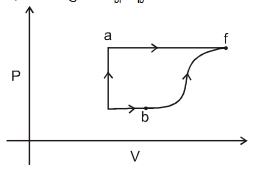
A thermodynamic system is taken form an initial state $i$ with internal energy $U_1=100 \ J$ to the final state along two different paths iaf and ibf, as schematically shown in the fire. The work done by the system along the paths $af$, ib and bf are $W _{ af }=200 \ J , W _{ ID }=50 \ J$ and $W _{ br }=100 \ J$ respectively. The heat supplied to the system along the path iaf, ib and bf are $Q_{\mid a t l} Q_{b r}$ and $Q_{10}$ respectively. If the internal energy of the sytem in the state $b$ is $U_b=$ $200 \ J$ and $Q_{l a t}=500 \ J$, the ratio $Q_{b J} / Q_{10}$ is:
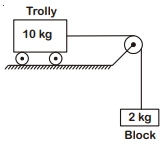
Calculate the acceleration (In $m/s^{2}$) of the block and trolly system shown in the figure. The coefficient of kinetic friction between the trolly and the surface is $0.05 .\left( g =10\; m / s ^{2},\right.$ mass of the string is negligible and no other friction exists).
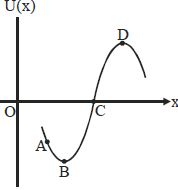
Potential energy of a particle varies with distance $x$ as shown in the graph Select the wrong statement