Question
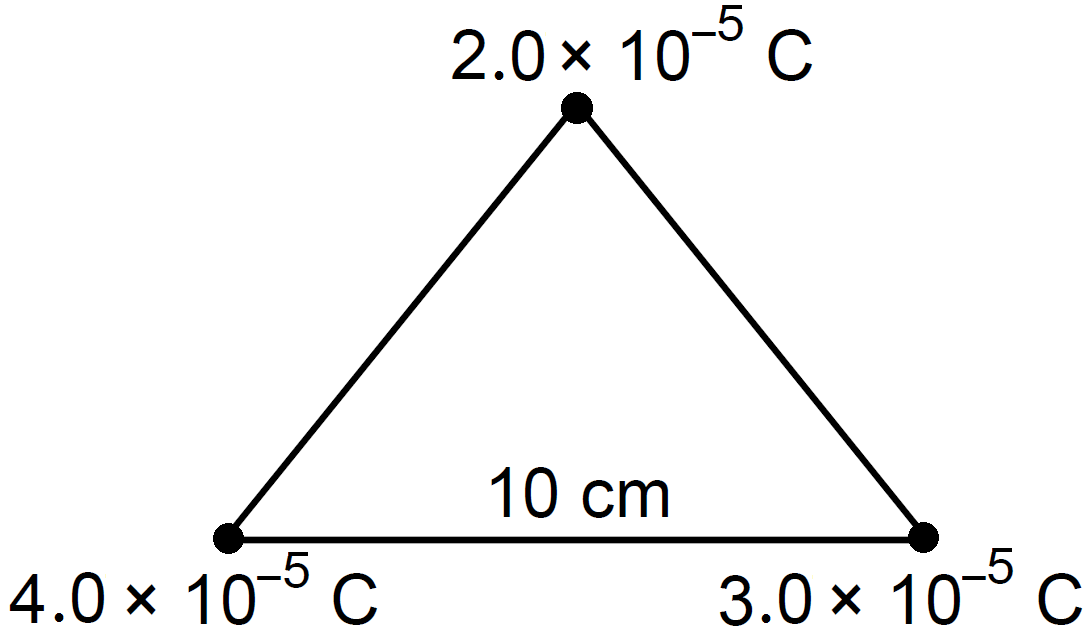
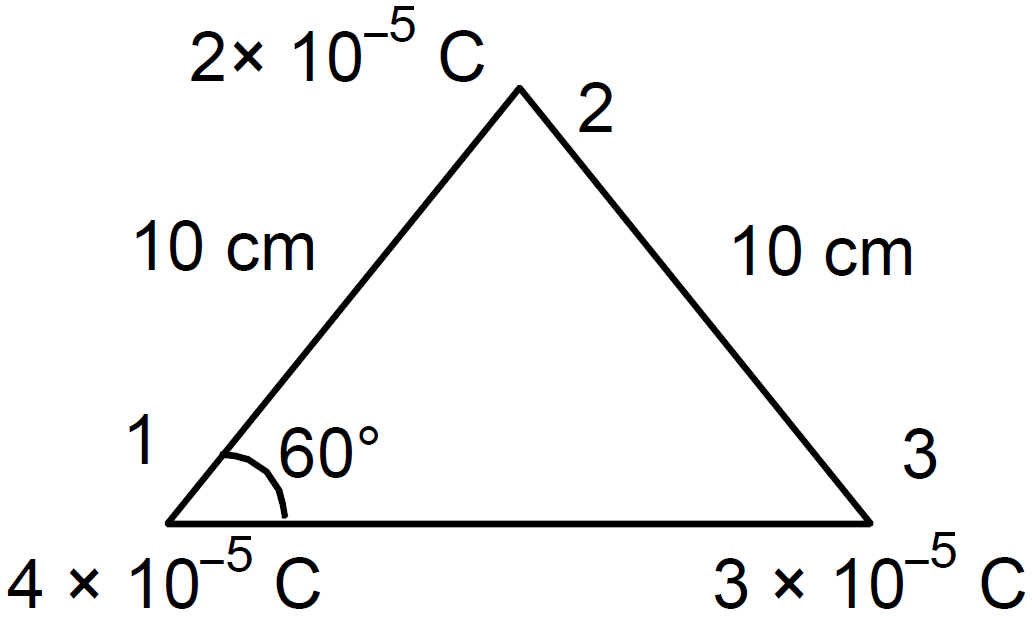
How much work has to be done in assembling three charged particles at the vertices of an equilateral triangle as shown in figure?
Answer

Amount of work done is assembling the charges is equal to the net potential energy So, P.E. $=\text{U}_{12}+\text{U}_{13}+\text{U}_{23}$$=\frac{\text{Kq}_1\text{q}_2}{\text{r}_{12}}+\frac{\text{Kq}_1\text{q}_3}{\text{r}_{13}}+\frac{\text{Kq}_2\text{q}_3}{\text{r}_{23}}$
$=\frac{\text{K}+10^{10}}{\text{r}}[4\times2+4\times3+3\times2]$
$=\frac{9\times10^9\times10^{10}}{10^{-1}}(8+12+6)$
$=9\times26$
$=234\text{J}$

Need a full question paper?

Generate a complete, print-ready paper with questions like this in minutes — across 16+ boards, with answer keys.
Start Generating Free

Similar questions

Explain why. There is no atmosphere on moon.
A box of 1.00m3 is filled with nitrogen at 1.5 atm at 300K. The box has a hole of an area 0.010 mm2. How much time is required for the pressure to reduce by 0.10atm, if the pressure outside is 1atm.
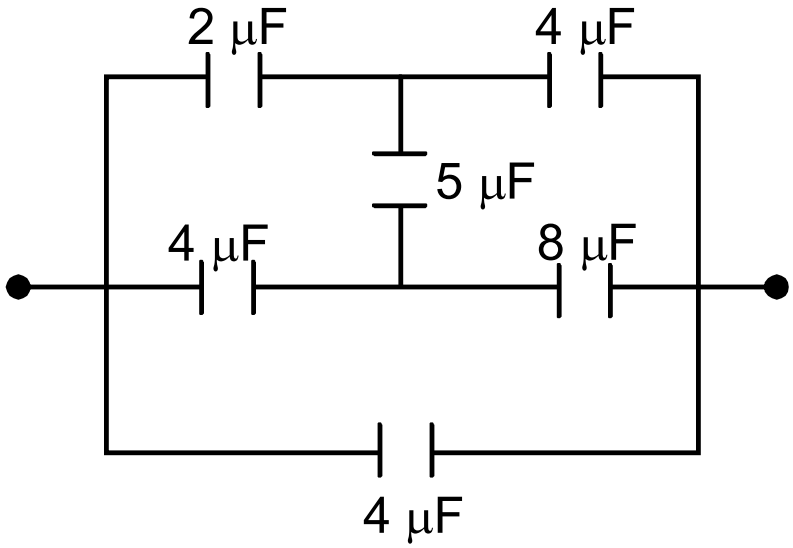
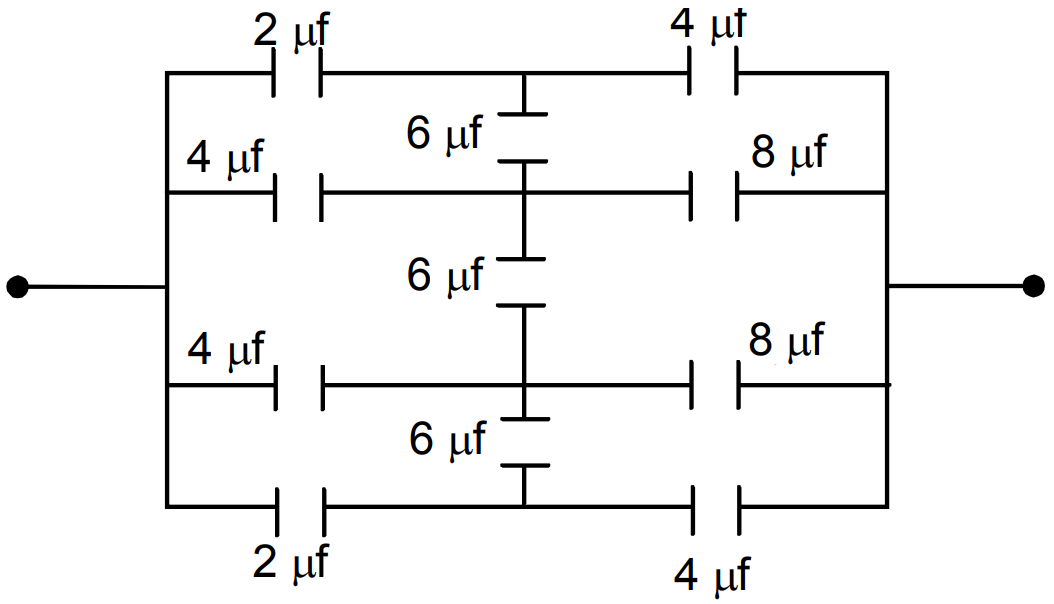
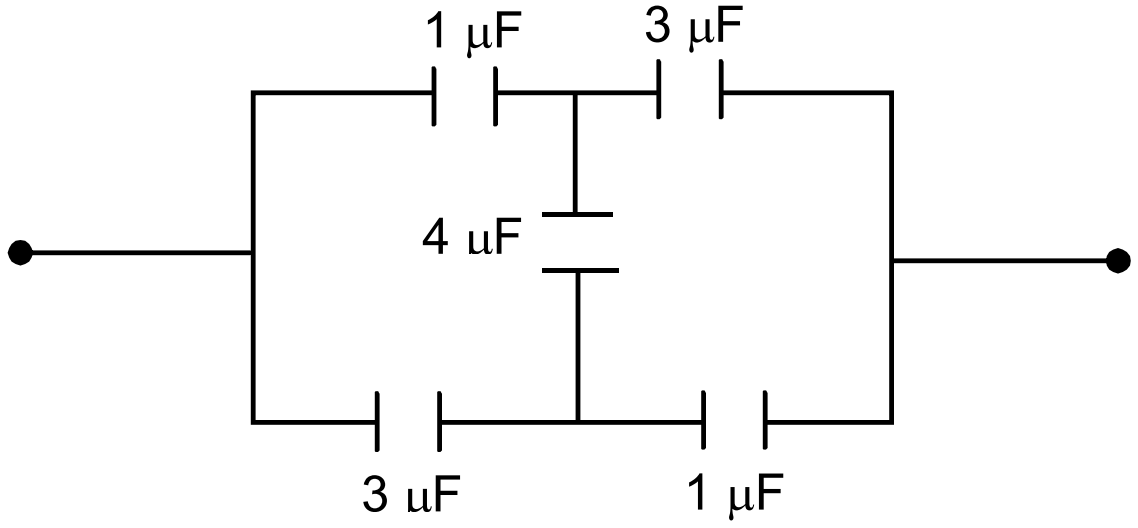
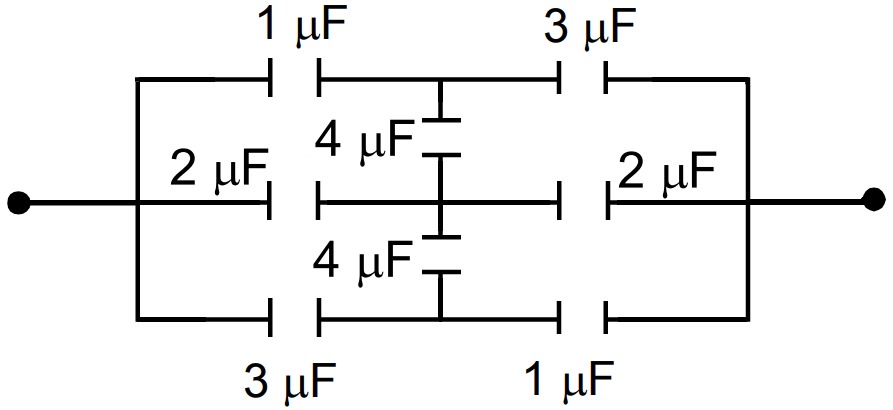
Find the equivalent capacitances of the combinations shown in figure between the indicated points.


Prove that at any point in the PV diagram, the slope of the adiabatic curve is $\gamma$ times the slope of the isothermal curve. Make necessary diagram.
Consider the situation of the previous problem:
  1. Find the tension in the string in equilibrium.
  2. Suppose the ball is slightly pushed aside and released. Find the time period of the small oscillations.
A venturimeter is connected to two points in the mains where its radii are 20cm and 10cm, respectively, and the levels of water column in the tubes differ by 10cm. How much water flows through the pipe per minute?
Ten small planes are flying at a speed of 150km/h in total darkness in an air space that is 20 × 20 × 1.5km 3 in volume. You are in one of the planes, flying at random within this space with no way of knowing where the other planes are. On the average about how long a time will elapse between near collision with your plane. Assume for this rough computation that a safety region around the plane can be approximated by a sphere of radius 10m.
What is meant by elastic potential energy? Derive an expression for the elastic potential energy of a stretched wire. Prove that its elastic energy density is equal to $\frac{1}{2}\text{stress}\times\text{strain}.$
A transverse harmonic wave on a string is described by
$\text{y}(\text{x, t})=3.0\sin\big(36\text{t}+0.018\text{x}+\frac{\pi}{4}\big)$
where x and y are in cm and t in s. The positive direction of x is from left to right.
Is this a travelling wave or a stationary wave?
If it is travelling, what are the speed and direction of its propagation?
Consider the situation of the previous problem. Suppose each of the blocks is pulled by a constant force F instead of any impulse. Find the maximum elongation that the spring will suffer and the distances moved by the two blocks in the process.