Question
What is meant by elastic potential energy? Derive an expression for the elastic potential energy of a stretched wire. Prove that its elastic energy density is equal to $\frac{1}{2}\text{stress}\times\text{strain}.$

Answer

When a wire is stretched, some work is done against the internal restoring forces acting between particles of the wire. This work done appears as elastic potential energy in the wire. Consider a wire of length l and area of cross-section a. Let F be the stretching force applied on the wire and $\Delta\text{l}$ be the increase in length of the wire. Initially, the internal restoring force was zero but when the length is increased by $\Delta\text{l},$ the internal force increases from 0 to F(applied force). Thus, average initial force on an increase in length $(\Delta\text{l},)$ of the wire, $=\frac{0+\text{F}}{2}=\frac{\text{F}}{2}.$ Hence, work done on the wire, W = Average force × Increase in length, $=\frac{\text{F}}{2}\times\Delta\text{l}$ This is stored as elastic potential energy U in the wire, $\therefore\text{U}=\frac{1}{2}\text{F}\times\Delta\text{l}=\frac{1}{2}\frac{\text{F}}{\text{a}}\times\frac{\Delta\text{l}}{\text{l}}\times\text{al}$ $=\frac{1}{2}(\text{Stress})\times(\text{Strain)}\times\text{Volume of the wire}$ $\therefore$ Elastic potential energy per unit volume of the wire is given by, $\text{u}=\frac{\text{U}}{\text{al}}=\frac{1}{2}\times\text{Stress}\times\text{Strain}$

Need a full question paper?

Generate a complete, print-ready paper with questions like this in minutes — across 16+ boards, with answer keys.
Start Generating Free

Similar questions

A helicopter of mass $1000kg$ rises with a vertical acceleration of $15ms^{-2}$. The crew and the passengers weigh $300kg$. Give the magnitude and direction of the,
  1. Force on the floor by the crew and passengers.
  2. Action of the rotor of the helicopter on the surrounding air.
  3. Force on the helicopter due to the surrounding air.
Define linear momentum. Prove that for fixed mass, $P \propto v$ and for constant momentum $v \propto \frac{1}{m}$.
A parallel-plate capacitor has plate area $100cm^2$ and plate separation 1.0cm. A glass plate (dielectric constant 6.0) of thickness 6.0mm and an ebonite plate (dielectric constant 4.0) are inserted one over the other to fill the space between the plates of the capacitor. Find the new capacitance.
Can the work by kinetic friction on an object be positive? Zero?
A 6.5m long ladder rests against a vertical wall reaching a height of 6.0m. A 60kg man stands half way up the ladder.
  1. Find the torque of the force exerted by the man on the ladder about the upper end of the ladder.
  2. Assuming the weight of the ladder to be negligible as compared to the man and assuming the wall to be smooth, find the force exerted by the ground on the ladder.
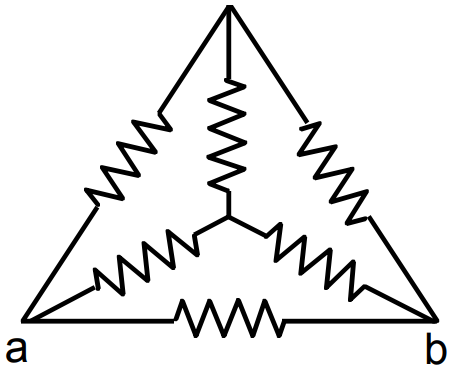
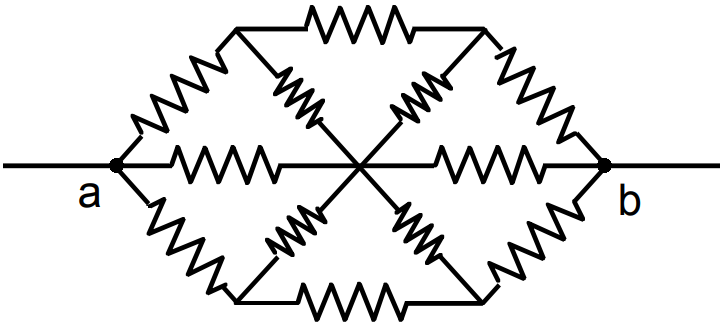
Find the equivalent resistance of the circuits shown in the figure. between the points a and b. Each resistor has resistance r.

A uniform wheel of radius R is set into rotation about its axis at an angular speed $\omega.$ This rotating wheel is now placed on a rough horizontal surface with its axis horizontal. Because of friction at the contact, the wheel accelerates forward and its rotation decelerates till the wheel starts pure rolling on the surface. Find the linear speed of the wheel after it starts pure rolling.
A metal bar 70 cm long and 4.00 kg in mass supported on two knifeedges placed 10 cm from each end. A 6.00 kg load is suspended at 30 cm from one end. Find the reactions at the knife-edges. (Assume the bar to be of uniform cross section and homogeneous.)
A pebble of mass $0.05kg$ is thrown vertically upwards. Give the direction and magnitude of the net force on the pebble,
  1. During its upward motion
  2. During its downward motion.
  3. At the highest point where it is momentarily at rest. Do your answers change if the pebble was thrown at an angle of $45°$ with the horizontal direction? Ignore air resistance.
If a sphere of radius r falls under gravity through a liquid of viscosity $\eta,$ its average acceleration is half that of in starting of the motion. Then, show that the time taken by it to attain the terminal velocity is independent of the liquid density.