Question
How the photoelectric effect depends on time? Explain.

Answer

Experimental studies of photoelectric effect have shown that if the frequency of incident radiation is greater than the threshold frequency of a photosensitive metal, electrons are instantaneously emitted from the metal, even for low intensities.
If the frequency is greater than the threshold frequency, electrons are emitted in only $10^{-9}$ sec or less.

Need a full question paper?

Generate a complete, print-ready paper with questions like this in minutes — across 16+ boards, with answer keys.
Start Generating Free

Similar questions

A rectangular coil of $100$ turns has length $5\ cm$ and width $4\ cm$. It is placed with its plane parallel to a uniform magnetic field and a current of $2A$ is sent through the coil. Find the magnitude of the magnetic field $B$ if the torque acting on the coil is $0.2\ N m^{-1}.$
Is some work performed by a magnetic field on an electric charge moving in the field ?
Radioactive $^{131}$I has a half$-$life of $8.0$ days. A sample containing $^{131}$I has activity $20\mu\text{Ci}$ at $t = 0.$
  1. What is its activity at $t = 4$ days?
  2. What is its decay constant at $t = 4.0$ days?
Write formula for Bohr's orbit radius for hydrogen atom.
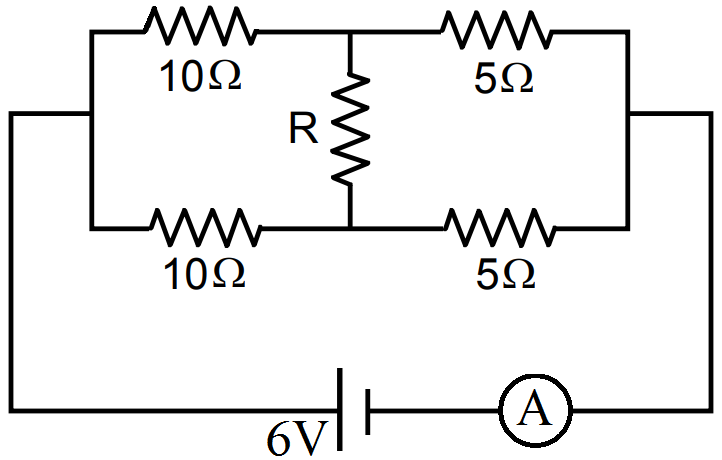
What should be the value of R in the figure. for which the current in it is zero?
The electric field E due to a point charge at any point near it is defined as $\text{E} = \DeclareMathOperator*{\median}{\text{lim}} \median_{\text{q}\rightarrow0}\frac{\text{F}}{\text{q}}$ where q is the test charge and F is the force acting on it. What is the physical significance of $\DeclareMathOperator*{\median}{\text{lim}} \median_{\text{q}\rightarrow0}$ in this expression? Draw the electric field lines of a point charge Q when (a) Q>0 and (b) Q<0. 
Write the limitations of Bohr model.
A nearsighted person cannot clearly see beyond 200cm. Find the power of the lens needed to see objects at large distances.
An electric dipole is placed inside a closed surface, whose dipole moment is $20 \times 10^{-6}$ coulomb-meter. What will be the electric flux emerging out of this surface?
Explain the observation of Hallwachs and Lenard for the photoelectric effect.