Question
How to use Kirchhoff's rules ?

Answer

First, label currents in each resistor by symbol I and a directed arrow to indicate that a current flows along the resistor in the direction indicated.
If ultimately I is to be positive, the actual current in the resistor is in the direction of the arrow.
If I turns out to be negative, the current actually flows in a direction opposite to the arrow.
For each source (i.e cell or some other source of electrical power) the positive and negative terminals are labelled as well as a directed arrow with a symbol for the current flowing through the cell.
The potential difference of the cell $V = V ( P )$ $- V ( N )=\varepsilon- I r$ which is between the positive terminal P and negative terminal N .
If while labelling the current through the cell goes from P to N then $V =\varepsilon+ Ir$.

Need a full question paper?

Generate a complete, print-ready paper with questions like this in minutes — across 16+ boards, with answer keys.
Start Generating Free

Similar questions

Two beams, one of red light and the other of blue light, of the same intensity are incident on a metallic surface to emit photoelectrons. Which one of the two beams emits electrons of greater kinetic energy?
Why is the de Broglie wavelength associated with macroscopic objects (cricket ball, car, etc.) not observed in daily life?
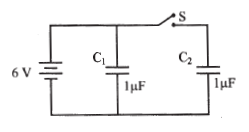
Figure shows two identical capacitors, $C_1$ and $C_2,$ each of $1 \mu F$ capacitance connected to a battery of $6 V.$ Initially switch $'S\ '$ is closed. After sometime $'S\ '$ is left open and dielectric slabs of dielectric constant $K = 3$ are inserted to fill completely the space between the plates of the two capacitors. How will the $(i)$ charge and $(ii)$ potential difference between the plates of the capacitors be affected after the slabs are inserted?
Can the dispersive power $\omega=\frac{\mu_\text{v}-\mu\text{r}}{\mu-1}$ be negative? What is the sign of co if a hollow prism is immersed into water?
A heavy box is kept on a smooth inclined plane and is pushed up by a force F acting parallel to the plane. Does the work done by the force F as the box goes from A to B depend on how fast the box was moving at A and B? Does the work by the force of gravity depend on this?
Define wavefront of a travelling wave. Using Huygens principle, obtain the law of refraction at a plane interface when light passes from a denser to rarer medium.
Draw the phasor diagram and graph of voltage and current versus $\omega t$  for a purely capacitive circuit and explain it.
Why is wave theory of electromagnetic radiation not able to explain photo electric effect? How does photon picture resolve this problem?
Two protons and two electrons are hanging freely at equal distances. Compare the repulsion force between proton and electron.
Explain the Construction and working of gold leaf electroscope.