Question
How will an air bubble behave like a lens in water?

Answer

Both the surfaces of the air bubble are convex. Hence this behaves like a convex lens. But the refractive index of water is greater than the refractive index of air. Therefore, due to the change in the nature of the air bubble present in the water tank, it will act like a concave lens.

Need a full question paper?

Generate a complete, print-ready paper with questions like this in minutes — across 16+ boards, with answer keys.
Start Generating Free

Similar questions

A point charge ' $q$ ' is placed at point $O$ as shown in the figure. Will $\left(V_A-V_B\right)$ be positive, negative or zero if $q$ is (i) positive (ii) negative.
"Monochromatic light should be used to produce pure spectrum". Comment on this statement.
What is called polar and non-polar atom ? Give example of it.
Complete the following decay schemes.
  1. $\text{ }^{226}_{88}\text{Ra}\rightarrow\alpha+$
  2. $\text{ }^{19}_8\text{O}\rightarrow\text{ }^{19}_9\text{F}+$
  3. $\text{ }^{25}_{13}\text{Al}\rightarrow\text{ }^{25}_{12}\text{Mg}+$
Heat at the rate of 200W is produced in an X-ray tube operating at 20kV. Find the current in the circuit. Assume that only a small fraction of the kinetic energy of electrons is converted into X-rays.
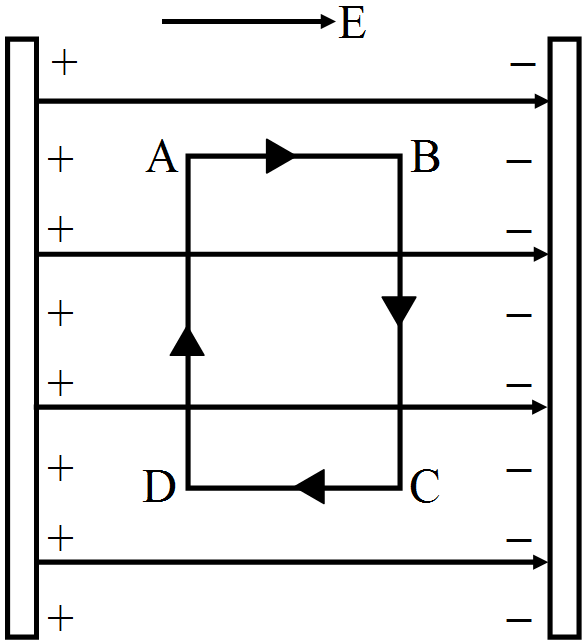
A uniform electric field exists between two charged plates as shown in the fig. What should be the work done in moving a charge $q$ along the closed rectangular path $\text{ABCD}$?
A cell of emf $ 'E\ ’$ and internal resistance $\ 'r\ ’$ is connected across a variable resistor $' R\ ’.$ Plot a graph showing variation of terminal voltage $' V\ ’$ of the cell versus the current $' I\ ’.$ Using the plot, show how the emf of the cell and its internal resistance can be determined.
Electrons are emitted from an electron gun at almost zero velocity and are accelerated by an electric field $E$ through a distance of $1.0m.$ The electrons are now scattered by an atomic hydrogen sample in ground state. What should be the minimum value of $E$ so that red light of wavelength $656.3\ nm$ may be emitted by the hydrogen?
The internal resistance of an accumulator battery of emf 6V is $10\Omega$ when it is fully discharged. As the battery gets charged up, its internal resistance decreases to $1\Omega.$
The battery in its completely discharged state is connected to a charger that maintains a constant potential difference of 9V. Find the current through the battery (a) just after the connections are made and (b) after a long time when it is completely charged.
A point charge is placed at the centre of a closed Gaussian spherical surface of radius r. Electric flux passing through the surface is $\Phi$ How is the electric flux $\Phi$ through the surface affected when the following changes are made in turn:
  1. The spherical surface is replaced by a cylindrical surface of the same radius?
  2. The point charge is replaced by an electric dipole?
Justify your answer in each case.