MCQ
Human eye:
- ACan detect polarized light
- BCannot detect polarization of light
- CCan detect only circularly polarized light
- DCan detect only linearly polarized light
Explanation:
Polarization changes when plane of vibration of polarized light changes.
Human eye is insensitive to change in polarization and hence, cannot detect polarization of light.
Generate a complete, print-ready paper with questions like this in minutes — across 16+ boards, with answer keys.
Two resistance wires on joining in parallel the resultant resistance is  . One of the wire breaks, the effective resistance is 2 ohms. The resistance of the broken wire is
|
(a) |
(b) 2 ohm |
(c) |
(d) 3 ohm |
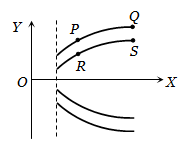
In Thomson spectrograph experiment, four positive ions P,Q,R and S are situated on Y-X curve a shown in the figure
|
(a) The specific charge of R and S are same |
|
(b) The masses of P and S are same |
|
(c) The specific charges of Q and R are same |
|
(d) The velocities of R and S are same |
A double convex lens of glass of m = 1.5 has radius of curvature of each of its surface is 0.2 m. The power of the lens is
|
(a) + 10 dioptres |
(b) – 10 dioptres |
(c) – 5 dioptres |
(d) +5 dioptres |
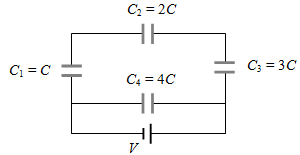
A network of four capacitors of capacity equal to  and
and  are conducted in a battery as shown in the figure. The ratio of the charges on
  and
and  is
is
|
(a) |
(b) |
(c) |
(d) |
The nuclear reaction  (mass of deuteron = 2.0141 a.m.u. and mass of He = 4.0024 a.m.u.) is
|
(a) Fusion reaction releasing 24 MeV energy |
|
(b) Fusion reaction absorbing 24 MeV energy |
|
(c) Fission reaction releasing 0.0258 MeV energy |
|
(d) Fission reaction absorbing 0.0258 MeV energy |


