MCQ
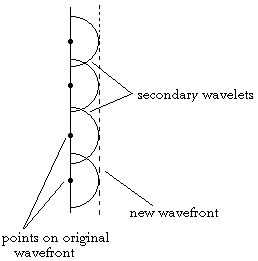
Huygens's concept of secondary wave:
- AAllows us to find the focal length of a thick lens.
- BIs a geometrical method to a find a wavefront.
- CIs used to determine the velocity of light.
- DIs used to explain polarisation.
Explanation:
Huygens principle states that "Every point on a wave-front may be considered a source of secondary spherical wavelets which spread out in the forward direction at the speed of light. The new wave-front is the tangential surface to all of these secondary wavelets."
Thus it is geometrical method to find the wavefront.
Generate a complete, print-ready paper with questions like this in minutes — across 16+ boards, with answer keys.

The equivalent resistance between x and y in the circuit shown is

|
(a) 10 W |
(b) 40 W |
(c) 20 W |
(d) |
In the diagram shown, the reading of voltmeter is 20 V and that of ammeter is 4 A. The value of R should be (Consider given ammeter and voltmeter are not ideal)

|
(a) Equal to 5Ω |
|
(b) Greater from 5 Ω |
|
(c) Less than 5 Ω |
|
(d) Greater or less than 5 Ω depends on the material of R |
Which of the following statements are true regarding radioactivity
(I) All radioactive elements decay exponentially with time
(II) Half life time of a radioactive element is time required for one half of the radioactive atoms to disintegrate
(III) Age of earth can be determined with the help of radioactive dating
(IV) Half life time of a radioactive element is 50% of its average life period
Select correct answer using the codes given below
Codes :
|
(a) I and II |
(b) I, III and IV |
(c) I, II and III |
(d) II and III |
A wire carrying current I and other carrying 2I in the same direction produces a magnetic field B at the mid point. What will be the field when 2I wire is switched off
|
(a) B / 2 |
(b) 2B |
(c) B |
(d) 4B |
For production of characteristic  X-rays, the electron transition is
|
(a) n = 2 to n = 1 |
(b) n = 3 to n = 2 |
(c) n = 3 to n = 1 |
(d) n = 4 to n = 2 |
Dispersion can take place for
|
(a) Transverse waves only but not for longitudinal waves |
|
(b) Longitudinal waves only but not for transverse waves |
|
(c) Both transverse and longitudinal waves |
|
(d) Neither transverse nor longitudinal waves |
