Question
$(i) (a)$ Define work and state the mathematical expression for work.
$(b)$ State $\text{CGS}$ and $SI$ unit of work.
$(ii)$ An electric pump is $60 \%$ efficient and is rated $2 HP$ . Calculate the maximum amount of water it can lift through a height of $5 m$ in $40 s .\  [$Take $g =10 ms^{-2}$ and $1 HP =750 W$ ]
$(iii)$ In a hydroelectric power station, $1000 \ kg$ water is allowed to drop through a height of $100 m$ in $1s$ . If the conversion of potential energy to electric energy is $60 \%$, calculate the power output in $kW ($take $g =10 m / s ^2).$
Answer

$(i) (a)$ Work is said to be done only when the force applied on a body causes a displacement of the body in the direction of force or any resolved component of the force.
Mathematically, work is the product of force and the displacement in the direction of force.
$W=\overrightarrow{F} \cdot \overrightarrow{S}=FS \cos \theta$
$(b) \ \text{CGS}$ unit of work $- \text{erg}$
$SI$ unit of work $- $joule
$(ii)$ Energy supplied to the motor $= P \times t$
$ 2 HP \times 40 s=2 \times 750 W \times 40 s=1500 W \times 40 s=6 \times 10^4 J$
Useful work done by the motor $=6 \times 10^4 J \times \frac{60}{100}=36000 J$
Useful work done in lifting water $=m \ \text{mgh}$
$=m \times 10 ms^{-2} \times 5 m$
$\Rightarrow m \times 50 m^2 s^{-2}=36000 J$
$\therefore m=\frac{36000 J}{50 m^2 s^{-2}}=720 \ kg$
$(iii) \ P.E$. of water $= \text{mgh} =1000 \ kg \times 10 ms^{-2} \times 100 m=10^6 J$
Useful $P.E. =10^6 J \times \frac{60}{100}=6 \times 10^5 J$
$\therefore$ Electrical power output $=\frac{ W }{t}=\frac{6 \times 10^5 J}{1 s}$
$=6 \times 10^5 W$
$=6 \times 10^2 kW=600 kW$.

Need a full question paper?

Generate a complete, print-ready paper with questions like this in minutes — across 16+ boards, with answer keys.

Start Generating Free

Similar questions

State two advantages and disadvantages of using wind energy for producing electricity.
Trace a ray of light incident at 30° on a surface if travelling from air to glass. What is the angle of refraction in this case? (R.I. for glass = 3/2).
You are provided with three resistors of resistance 1.0 Ω, 2.0 Ω and 3.0 Ω How would you connect them to obtain the total effective resistance 1.5 Ω? Draw diagram of the arrangement and check it by calculations.
A transformer is designed to work from a 240 V a.c. mains and to give a supply of 8 V to ring
a house–bell. The primary coil has 4800 turns. How many turns will be in the secondary coil?
If there is a convex lens of focal length 75 cm and a concave lens of focal length 40 cm, then calculate their combined power and combined focal length.
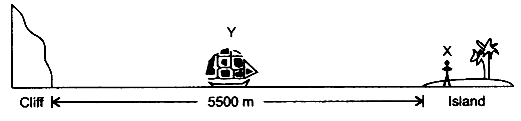
An observer $X$ is on an island $5500 m$ from a vertical cliff on the shore. A ship Y is anchored between the island and the Cliff. A blast on the ship's siren is heard twice by $X$, the interval being 5 s . [Velocity of sound $=330 ms-1$ ]

(i) Find the distance of the ship from the island.
(i) Find the distance of the cliff from the ship.
The following are some of the energy transformations.
A. Electrical to light
B. Work to heat
C. Chemical to light
D. Electrical to sound
E. Mechanical to electrical
Identify the energy transformation that takes place in the following by inserting the corresponding letter in the shape provided.
(i) A candle flame
(ii) A torch is lighted
(iii) A microphone is used in a meeting
(iv) A cycle dynamo
(v) A piece of metal is being filed
A person standing between two vertical cliffs and is $640$ m away from the nearest cliff. He shouted and heard the first echo after $45s$ and the second echo after further $3s$. Calculate the speed of sound in air and the distance between the cliffs.
A force of $1$ kgf displaces a body by a distance of $10 \ cm$
(i) in direction of force,
(ii) normal to the force
(iii) at an angle of $60^\circ $ to the direction of the force.
Calculate the amount of work done in each case. (Take: $g = 9.8 ms^{−2}$ )
Suppose there are three resistors $A, B,$ and $C$ having resistances $r_1, r_{2,}$ and $r_3$ respectively. If $R$ represents their equivalent resistance, establish the following relation $R = r_1 + r_2+ r_3$ when joined in series.