A lead pellet of mass 4 g leaves an air gun with a velocity of $50 ms^{-1}$. What is the magnitude of potential energy stored by the spring of air gun?
View full solution →Question types
Work, Power and Energy question types
58 questions across 6 question groups — pick any mix to generate a Physics paper with step-by-step answer keys.
58
Questions
6
Question groups
5
Question types
01
[1 Mark Question Answer]
10 Q→02[2 Mark Question Answer]
7 Q→03[3 Mark Question Answer]
2 Q→04[5 Mark Question Answer]
4 Q→05MCQ
30 Q→06fill in the blanks.
5 Q→Sample Questions
Work, Power and Energy questions
One sample from each question group in this chapter. Select any group above to see the full set with answer keys.
The heart of running athlete is beating 100 times a minute. If the work done by the heart per beat is 1.2 J , calculate the power of the heart.
For how long must an electric motor pump of $2 HP$ operate, so as to pump $5 m^3$ of water from a depth of $15 m ? [$Take $g =10 N / kg , 1 m^3$ of water $=10^3 kg, 1 HP =750 W$ ]
View full solution →What force must be applied to a body through a distance of $10 m$ , such that it does a work of $4000 J$ ? If the mass of body is $20 \ kg$ , what is the acceleration of the body?
View full solution →A boy of mass 55 kg runs up a flight of 40 stairs, each measuring 0.15 m in 15 s calculate: [Take $g =10 ms^{-2}$ ]
(a) work done by the boy
(b) power developed by the boy
View full solution →(a) work done by the boy
(b) power developed by the boy
A simple pendulum is suspended from a rigid support $O$. Its resting position is at mean position $A$. When it pulled to one side and then released, it oscillates from one side to other. In doing so it moves equal distance and equal height on either side as shown in the figure.
Complete the table, using the labels from the figure. The first label is done for you.
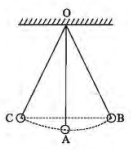
View full solution →Complete the table, using the labels from the figure. The first label is done for you.
| S.No | Description | Label |
| (a) | Potential energy at point A | 0 (zero) |
| (b) | The point(s) having maximum velocity | |
| (c) | The point(s) having minimum velocity | |
| (d) | The point(s) having maximum kinetic energy | |
| (e) | The point(s) having minimum potential energy |
Adjacent diagram shows a body of mass 5 kg pulled up an inclined plane by a force of 30 N .
(a) Calculate force of gravity acting on body. (Take $g =10 ms^{-2}$ )
(b) Work done by the force in pulling body along the inclined plane.
(c) Work done against the force of gravity.
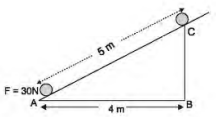
View full solution →(a) Calculate force of gravity acting on body. (Take $g =10 ms^{-2}$ )
(b) Work done by the force in pulling body along the inclined plane.
(c) Work done against the force of gravity.
A compressed spring is held near a small toy car of mass 0.15 kg . On the release of the spring, the toy car moves forward with a velocity of $10 ms^{-1}$. Find the potential energy of the spring.
View full solution →Calculate the power of an electric pump in horse power, which can lift $2000 m^3$ of water from a depth of 20 m in 25 minutes. [Take $g=10 ms^{-2}, 1 m^3$ of water $=10^3 kg$ and $1 HP =750 W$ ]
View full solution →State the energy changes taking place in the following cases:
(a) Glowing of a torch bulb
(b) An air gun is loaded and then fired
(c) Water in a dam rotates a turbine coupled to a generator
(a) Glowing of a torch bulb
(b) An air gun is loaded and then fired
(c) Water in a dam rotates a turbine coupled to a generator
(a) What is energy? State and define SI unit of energy.
(b) Define potential energy with an example.
(c) Define kinetic energy with an example
(b) Define potential energy with an example.
(c) Define kinetic energy with an example
(a) Define work.
(b) What are the conditions for doing work?
(c) State the mathematical expression for work.
(b) What are the conditions for doing work?
(c) State the mathematical expression for work.
(i) What is potential energy. Discuss about two types of potential energy.
(ii) (a) State law of conservation of energy.
(b) Write two examples of interconversion of energy.
(iii) A body A of mass 20 kg is moving with a velocity of $1 ms^{-1}$. Another body B of mass 1 kg is moving with a velocity of $20 ms^{-1}$. Find the ratio of kinetic energy of $A$ and $B$.
View full solution →(ii) (a) State law of conservation of energy.
(b) Write two examples of interconversion of energy.
(iii) A body A of mass 20 kg is moving with a velocity of $1 ms^{-1}$. Another body B of mass 1 kg is moving with a velocity of $20 ms^{-1}$. Find the ratio of kinetic energy of $A$ and $B$.
$(i) (a)$ Define work and state the mathematical expression for work.
$(b)$ State $\text{CGS}$ and $SI$ unit of work.
$(ii)$ An electric pump is $60 \%$ efficient and is rated $2 HP$ . Calculate the maximum amount of water it can lift through a height of $5 m$ in $40 s .\ [$Take $g =10 ms^{-2}$ and $1 HP =750 W$ ]
$(iii)$ In a hydroelectric power station, $1000 \ kg$ water is allowed to drop through a height of $100 m$ in $1s$ . If the conversion of potential energy to electric energy is $60 \%$, calculate the power output in $kW ($take $g =10 m / s ^2).$
View full solution →$(b)$ State $\text{CGS}$ and $SI$ unit of work.
$(ii)$ An electric pump is $60 \%$ efficient and is rated $2 HP$ . Calculate the maximum amount of water it can lift through a height of $5 m$ in $40 s .\ [$Take $g =10 ms^{-2}$ and $1 HP =750 W$ ]
$(iii)$ In a hydroelectric power station, $1000 \ kg$ water is allowed to drop through a height of $100 m$ in $1s$ . If the conversion of potential energy to electric energy is $60 \%$, calculate the power output in $kW ($take $g =10 m / s ^2).$
(i) State fhe law of conservation of energy.
(ii) Prove mathematically the law of conservation of energy.
(iii) Explain how a freely swinging pendulum obeys the law of conservation of energy.
(ii) Prove mathematically the law of conservation of energy.
(iii) Explain how a freely swinging pendulum obeys the law of conservation of energy.
Assertion (A): When a coolie walks on a horizontal ground while carrying a load on his head, no work is done against the force gravity.
Reason (A): The coolie does work against the force of friction when he moves with load.
Reason (A): The coolie does work against the force of friction when he moves with load.
- ABoth A and R are true and R is the correct explanantion of A .
- ✓Both A and R are true but R is not the correct explanation of A .
- CAssertion is false but reason is true.
- DAssertion is true but reason is false.
Answer: B.
View full solution →Assertion (A): In the uniform circular motion, the body is acted upon by a centripetal force, normal to displacement.
Reason (A): In the uniform circular motion, work done by the body is zero.
Reason (A): In the uniform circular motion, work done by the body is zero.
- ABoth A and R are true and R is the correct explanantion of A .
- ✓Both A and R are true but R is not the correct explanation of A .
- CAssertion is false but reason is true.
- DAssertion is true but reason is false.
Answer: B.
View full solution →The work done by a fielder when takes a catch in a cricket match is:
- Apositive
- ✓negative
- Ceither (a) or (b)
- Dneither (a) nor (b)
Answer: B.
View full solution →The energy conversion taking place in a solar cell is
- Afrom light energy to heat energy
- Bfrom chemical energy to light energy
- ✓from solar (light) energy to electric energy
- Dnone of these
Answer: C.
View full solution →The energy conversion taking place in a loud speaker is
- Afrom light energy to sound energy
- ✓from electric energy to sound energy
- Cfrom sound energy to electric energy
- Dnone of these
Answer: B.
View full solution →One ___________ [joule/erg of work is said to be done when a force of one ___________ [newton/ dyne] displaces a body through a distance of one metre in its own direction.
One horse power is equal to___________ [764/746/647] watt
The ___________ [power/energy/force] of a body is its capacity to do work.
The rate of doing work is called ___________ [energy/ capacity / power).
The coolie does work against the force of ___________(gravity/friction/resistive] when he moves carrying a load on his head.
Generate a Work, Power and Energy paper free
Pick question groups from the list above, set marks and difficulty, and export a branded PDF with step-by-step answer keys. First 3 chapters free — no signup.