MCQ
I a.m.u. is equivalent to the energy of :
- A1 eV
- B14.2 MeV
- ✓931 MeV
- D0.693 MeV
Generate a complete, print-ready paper with questions like this in minutes — across 16+ boards, with answer keys.
A parallel plate condenser has a capacitance 50μF in air and 110μF when immersed in an oil. The dielectric constant ‘k’ of the oil is
|
(a) 0.45 |
(b) 0.55 |
(c) 1.10 |
(d) 2.20 |
Radius of central zone of circular zone plate is 2.3 mm. Wavelength of incident light is 5893 . Source is at a distance of 6m Then the distance of first image will be
|
(a) 9 m |
(b) 12 m
|
(c) 24 m |
(d) 36 m |
In the above question, potential difference across the 40Ω resistance will be
|
(a) Zero |
(b) 80 V |
(c) 40 V |
(d) 120 V |
If the amplification factor of a triode (m) is 22 and its plate resistance is 6600 ohm, then the mutual conductance of this valve is mho is
|
(a) |
(b) 25 |
(c) |
(d) |
A point object O is placed on the principal axis of a convex lens of focal length 20 cm at a distance of 40 cm to the left of it. The diameter of the lens is 10 cm. If the eye is placed 60 cm to the right of the lens at a distance h below the principal axis, then the maximum value of h to see the image will be
|
(a) 0 |
(b) 5 cm |
(c) 2.5 cm |
(d) 10 cm |
The temperature at which thermal electric power of a thermo couple becomes zero is called
|
(a) Inversion temperature |
(b) Neutral temperature |
|
(c) Junction temperature |
(d) Null temperature |
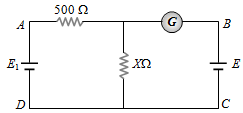
In the adjoining circuit, the battery  has an e.m.f of 12 volt and zero internal resistance while the battery E has an e.m.f of 2 volt. If the galvanometer G reads zero, then the value of the resistance X in ohm is
|
(a) 10 |
(b) 100 |
(c) 500 |
(d) 200 |
Consider four circuits shown in the figure below. In which circuit power dissipated is greatest (Neglect the internal resistance of the power supply)
|
(a)
|
(b)
|
(c)
|
(d)
|
If a proton is projected in a direction perpendicular to a uniform magnetic field with velocity v and an electron is projected along the lines of force, what will happen to proton and electron
|
(a) The electron will travel along a circle with constant speed and the proton will move along a straight line |
|
(b) Proton will move in a circle with constant speed and there will be no effect on the motion of electron |
|
(c) There will not be any effect on the motion of electron and proton |
|
(d) The electron and proton both will follow the path of a parabola |


