Question
(i) Define machine and write functions of a machine.
(ii) Describe mechanical advantage and its types.
(iii) (a) Derive relation between the efficiency, mechanical advantage, and the velocity ratio of a practical machine.
(b) Derive relation between ideal mechanical advantage and velocity ratio for a perfect machine
Answer

(i) Machine is a device by which we can overcome large resistance or gain speed or change the direction of effort applied, by applying comparatively a small force at a convenient point, and in a desired direction.
Functions of a machine are:
(a) A machine can multiply force.
(b) A machine can increase speed.
(c) A machine can change the direction of effort applied.
(ii) Mechanical advantage means advantage given by the machine, in terms of effort applied and load lifted by it. If a machine lifts a comparatively large load, compared to effort applied, then it has a positive mechanical advantage.
Mechanical advantage can be classified under two classes
(a) Ideal mechanical advantage: Ideal mechanical advantage is the ratio between the total load (useful load + resistance due to friction and movable parts of machine) moved to the effort applied.
(b) Actual mechanical advantage : Actual mechanical advantage is the ratio between the useful load moved to the effort applied.
(iii) Consider a perfect machine (whose parts are weightless and frictionless) in which an effort ' E ' causes a displacement 'D', when total load ' $L$ ', is displaced through a distance ' $d$ '.
$\therefore$ Output of the machine $=L \times d$
Input of the machine $=E \times D$.
By the principle of a perfect machine,
Output of the machine $=$ Input of the machine
$\begin{aligned} & L \times d=E \times D \\ \Rightarrow & \frac{L}{E}=\frac{D}{d} \\ \therefore & I M A = V R \end{aligned}$
However, if $L=l+x$, where $T$ is the useful load and $x$ is the resistance due to the movable parts of the machine and friction, etc., then from the above expression :
$\frac{L}{E}=\frac{D}{d} \Rightarrow \frac{l+x}{E}=\frac{D}{d}$
$\Rightarrow \frac{l}{E}+\frac{x}{E}=\frac{D}{d}$
$AMA +\frac{x}{E}= VR$
$\therefore \frac{x}{E}= VR - AMA$
$x= E ( VR - AMA )$
But $ V R=I M A$
$\therefore x=E($ IMA - AMA $)$

Need a full question paper?

Generate a complete, print-ready paper with questions like this in minutes — across 16+ boards, with answer keys.

Start Generating Free

Similar questions

A refrigerator converts $100 g$ of water at $20^{\circ} C$ to ice at $-10^{\circ} C$ in 73.5 min. Calculate the average
the rate of heat extraction in watt. The specific heat capacity of water is $4.2 Jkg ^{-1} K ^{-1}$ Specific latent heat of ice is $336 J g -1$ and the specific heat capacity of ice if $2.1 Jkg ^{-1} K ^{-1}$.
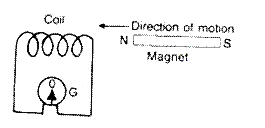
The following diagram shows a fixed coil of several turns connected to a
center zero galvanometer G and a magnet NS which can move.
(a) Describe the observation in the galvanometer if (i) The magnet is moved
rapidly in the direction of arrow, (ii ) The magnet is kept still after it has
moved into the coil, (iii ) The magnet~ then rapidly pulled out the coil.


(b) How would the observation alter if a more powerful magnet is used?
How will you determine the focal length of a convex lens by the plane mirror method?
Give the physical explanation for the difference between musical sounds and noises.
Some hot water was added to three times its mass of cold water at 10°C and the resulting temperature was found to be 20°C. What was the temperature of the hot water?
Give two differences between the radioactive decay and nuclear fission.
A certain nucleus X has a mass number 15 and atomic number 7. Find the number of neutrons. The nucleus X losses one α-particle and Express the change and write the symbol of the new nucleus.
A consumer uses 4 lamps of 60 watt, 2 lamps of 40 watt, and 2 lamps of 100 watt. All these are used for 6 hour daily. Find the total bill for 30 days when the rate of energy is 75 paise per unit and the meter rent is Rs. 1.
Define the term principal foci as applied to a concave lens. Illustrate your answer with the aid of proper diagrams. Show the focal length of the lens in the diagram.
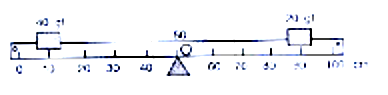
The figure shows a uniform metre rule placed on a function at its mid-point O and having a weight 40 gf at the 10 cm mark and a weight of 20 gf at the 9.0 cm mark.Is the metre rule in equilibrium?
If not how will the rule turn?