What is a pulley?
Question types
Machines question types
61 questions across 6 question groups — pick any mix to generate a Physics paper with step-by-step answer keys.
61
Questions
6
Question groups
5
Question types
01
[1 Mark Question Answer]
3 Q→02[2 Mark Question Answer]
16 Q→03[3 Mark Question Answer]
4 Q→04[5 Mark Question Answer]
4 Q→05MCQ
29 Q→06fill in the blanks.
5 Q→Sample Questions
Machines questions
One sample from each question group in this chapter. Select any group above to see the full set with answer keys.
View full solution →
What is the principle of lever?
What is a lever?
(a) Why the lever of the second order has mechanical advantage more than one?
(b) Why the lever of the third order has mechanical advantage less than one? Give one example of this class of lever.
(b) Why the lever of the third order has mechanical advantage less than one? Give one example of this class of lever.
The combination of two pulleys $P _1$ and $P _2$ are used to lift up a load $W$ as shown in the figure.
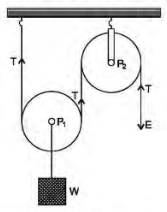
Complete the table using the labels from the figure. The first label is done for you.
View full solution →Complete the table using the labels from the figure. The first label is done for you.
| S.No | Description | Label |
| $(a)$ | Name the pulley $P_1$ | Movable |
| $(b)$ | Name the pulley $P_2$ | |
| $(c)$ | The pulley used to change the direction of effort | |
| $(d)$ | Relation between $T$ and $E$ | |
| $(e)$ | Relation between $E$ and $W$ |
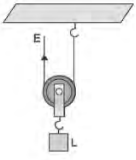
Explain Block and Tackle system of a pulley.
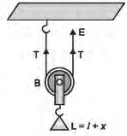
A pulley system has four pulleys in all and is 60% efficient, Calculate
(a) the mechanical advantage
(b) the effort required to lift a load of 1200 N,
(c) the resistance due to the movable parts and friction of the pulley system.
(a) the mechanical advantage
(b) the effort required to lift a load of 1200 N,
(c) the resistance due to the movable parts and friction of the pulley system.
How can a single pulley be used as a single movable pulley?
Draw diagrams of pulley systems having velocity ratio
(a) six (b) three.
(a) six (b) three.
Name and define three classes of levens and give two examples for each kind
To which order do the following levers belong and why?
(i) Railway signal, (ii) a man cutting bread with knife, (iii) a boy writing on a piece of paper,
(iv) nut-cracker, (v) handle of water pump, (vi) see-saw, (vii) forceps, (viii) a man rowing a boat,
(ix) lock and key, ( x ) opening of a soda water bottle, (xi) closing a door, (xii) motor car foot brake,
(xiii) nail cutter, (xiv) a fishing rod, (xv) a lemon squeezer.
(i) Railway signal, (ii) a man cutting bread with knife, (iii) a boy writing on a piece of paper,
(iv) nut-cracker, (v) handle of water pump, (vi) see-saw, (vii) forceps, (viii) a man rowing a boat,
(ix) lock and key, ( x ) opening of a soda water bottle, (xi) closing a door, (xii) motor car foot brake,
(xiii) nail cutter, (xiv) a fishing rod, (xv) a lemon squeezer.
(i) Define machine and write functions of a machine.
(ii) Describe mechanical advantage and its types.
(iii) (a) Derive relation between the efficiency, mechanical advantage, and the velocity ratio of a practical machine.
(b) Derive relation between ideal mechanical advantage and velocity ratio for a perfect machine
(ii) Describe mechanical advantage and its types.
(iii) (a) Derive relation between the efficiency, mechanical advantage, and the velocity ratio of a practical machine.
(b) Derive relation between ideal mechanical advantage and velocity ratio for a perfect machine
(i) (a) What is a machine?
(b) In reference to machine define effort and actual mechanical advantage.
(ii) Prove that efficiency of a machine is the ratio between mechanical advantage and the velocity ratio,
(iii) A machine displaces a load of 125 kgf through a distance 0.30 m, when an effort of 12.5 kgf acts through a distance of 4.0 m.
Calculate the (a) velocity ratio (b) mechanical advantage (c) % age efficiency of the machine
(b) In reference to machine define effort and actual mechanical advantage.
(ii) Prove that efficiency of a machine is the ratio between mechanical advantage and the velocity ratio,
(iii) A machine displaces a load of 125 kgf through a distance 0.30 m, when an effort of 12.5 kgf acts through a distance of 4.0 m.
Calculate the (a) velocity ratio (b) mechanical advantage (c) % age efficiency of the machine
(i) (a) What is a pulley?
(b) What is single fixed pulley system?.
(c) What is single movable pulley system?
(ii) A pulley system has five pulleys in all and is 90% efficient.
Calculate:
(a) the mechanical advantage
(b) the effort required to lift a load of 1000 N
(c) the resistance due to the movable parts of the machine and friction
(iii) Give reasons why single fixed pulley is commonly used.
(b) What is single fixed pulley system?.
(c) What is single movable pulley system?
(ii) A pulley system has five pulleys in all and is 90% efficient.
Calculate:
(a) the mechanical advantage
(b) the effort required to lift a load of 1000 N
(c) the resistance due to the movable parts of the machine and friction
(iii) Give reasons why single fixed pulley is commonly used.
Assertion $(A):$ A machine can have a mechanical advantage greater then its velocity ratio.
Reason $(A):$ A machine always has efficiency less than $100\%.$
Reason $(A):$ A machine always has efficiency less than $100\%.$
- ABoth $A$ and $R$ are true and $R$ is the correct explanation of $A$
- BBoth $A$ and $R$ are true but $R$ is not the correct explanation of $A$.
- ✓Assertion is false but reason is true.
- DAssertion is true but reason is false.
Answer: C.
View full solution →Assertion (A): If the displacement of load is equal to the displacement of the effort, then the velocity ratio of such machine is one.
Reason (A): Such a machine generally changes the direction of effort.
Reason (A): Such a machine generally changes the direction of effort.
- ABoth A and R are true and R is the correct explanation of A
- ✓Both A and R are true but R is not the correct explanation of A.
- CAssertion is false but reason is true.
- DAssertion is true but reason is false.
Answer: B.
View full solution →For levers of third order, the mechanical advantage is always
- Amore than one
- Bequal to one
- ✓less than one
- Dany one of these
Answer: C.
View full solution →For levers of second order, the mechanical advantage is always
- ✓more than one
- Bequal to one
- Cless than one
- Dall of these
Answer: A.
View full solution →For levers of first order, the mechanical advantage can have
- Agreater than one
- Bequal to one
- Cless than one
- ✓any one of these
Answer: D.
View full solution →The mechanical advantage of a lever is equal to the ratio of the length of its ___________ [effort/load] arm to the length of its [effori/load] arm.
In class III lever, the effort arm is always ___________ [larger than/smaller than/equal to] the load arm.
A class ___________ [I/II/III] lever always acts as a force multiplier.
The ___________ [load/effort/fulcrum] does not move, but remains fixed when the lever is in use
Actually, mechanical advantage for all practical machines is always ___________ [greater than/less than/equal to] its velocity ratio.
Generate a Machines paper free
Pick question groups from the list above, set marks and difficulty, and export a branded PDF with step-by-step answer keys. First 3 chapters free — no signup.