Question
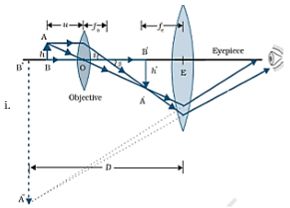
i. Draw a ray diagram showing the image formation by a compound microscope. Hence obtain the expression for total magnification when the image is formed at least distance of distinct vision.
iii. A compound microscope consists of an objective lens of focal length 2.0 cm and an eyepiece of focal length 6.0 cm. If they are separated by a distance of 24 cm, find the total magnification when the image is formed at infinity.
Answer

Image

Magnification due to objective
$m_0=\frac{h^{\prime}}{h}=\frac{L}{f_0}\left(\because \tan \beta=\frac{h}{f_0}=\frac{h}{L}\right)$
Magnification due to eye piece when final image is formed at the near point
$m _{ e }=1+\frac{D}{f_{ e }}$
Total magnification
$\begin{aligned} m & = m _0 m_{ e } \\
m & =\frac{L}{f_0}\left(1+\frac{D}{f_{ e }}\right)\end{aligned}$
ii.
$\begin{array}{l}m=\frac{L D}{f_o f_e} \\ m=\frac{24 \times 25}{2 \times 6}=\frac{600}{12}=50\end{array}$
Hence, the total magnification when the image is formed at infinity is 50.

Need a full question paper?

Generate a complete, print-ready paper with questions like this in minutes — across 16+ boards, with answer keys.

Start Generating Free

Similar questions

The conductivity of an intrinsic samiconductor depends on temperature as $\sigma=\sigma_0\text{ e}^{\frac{-\Delta\text{E}}{2\text{kT}}}$ where $\sigma_0$ is a constant. Find the temperature at which the conductivity pf an intrinsic germanium semiconductor will be double of its value at T = 300K. Assume that the gap for germanium is 0.650eV and remains constant as the temperature is increased.
Explain direct current direct emf and draw their graphs. Define alternating current and explain in detail.
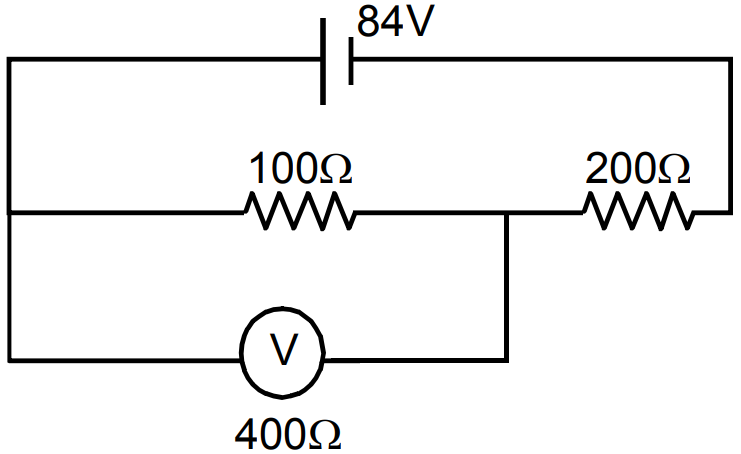
A voltmeter of resistance $400\Omega$ is used to measure the potential difference across the $100\Omega$ resistor in the circuit shown in the figure. (a) What will be the reading of the voltmeter? (b) What was the potential difference across $100\Omega$ before the voltmeter was connected?

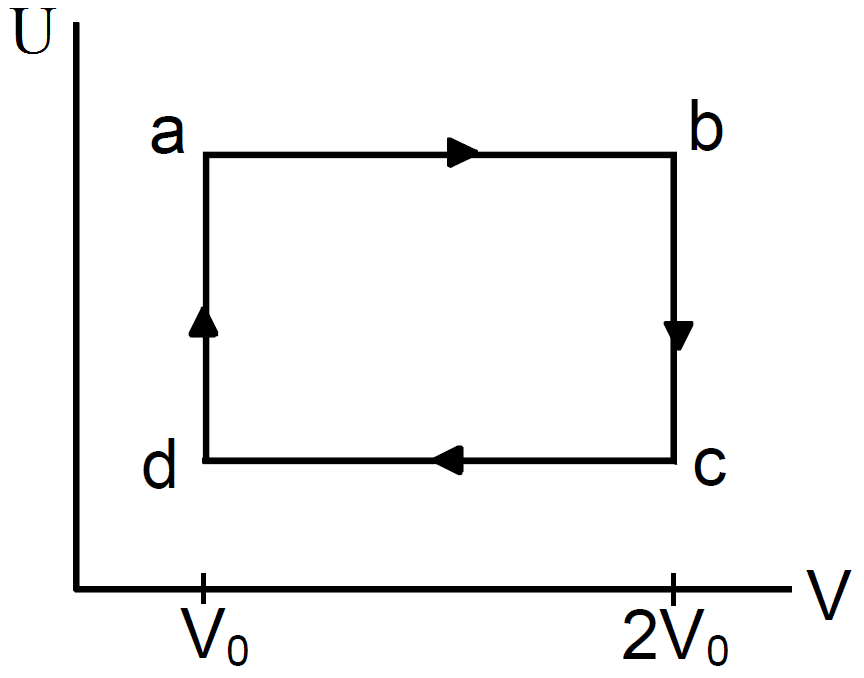
Figure. shows the variation in the internal energy U with the volume V of 2.0mol of an ideal gas in a cyclic process abcda. The temperatures of the gas at b and c are 500K and 300K respectively. Calculate the heat absorbed by the gas during the process.

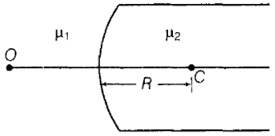
Figure shows a convex spherical surface with centre of curvature $C$ separating the two media of refractive indices $\mu_1$ and $\mu_2$. Draw a ray diagram showing the formation of the image of a point object $O$ lying on the principal axis. Derive the relationship between the object and image distance in terms of refractive indices of the media and the radius of curvature R of the surface.
Image
A particle A having a charge of 2.0 × 10-6C and a mass of 100g is placed at the bottom of a smooth inclined plane of inclination 30°. Where should another particle B, having same charge and mass, be placed on the incline so that it may remain in equilibrium?
Figure shows a charge array known as an electric quadrupole. For a point on the axis of the quadrupole, obtain the dependence of potential on r for r/a >> 1, and contrast your results with thatdue to an electric dipole, and an electric monopole (i.e., a single charge).

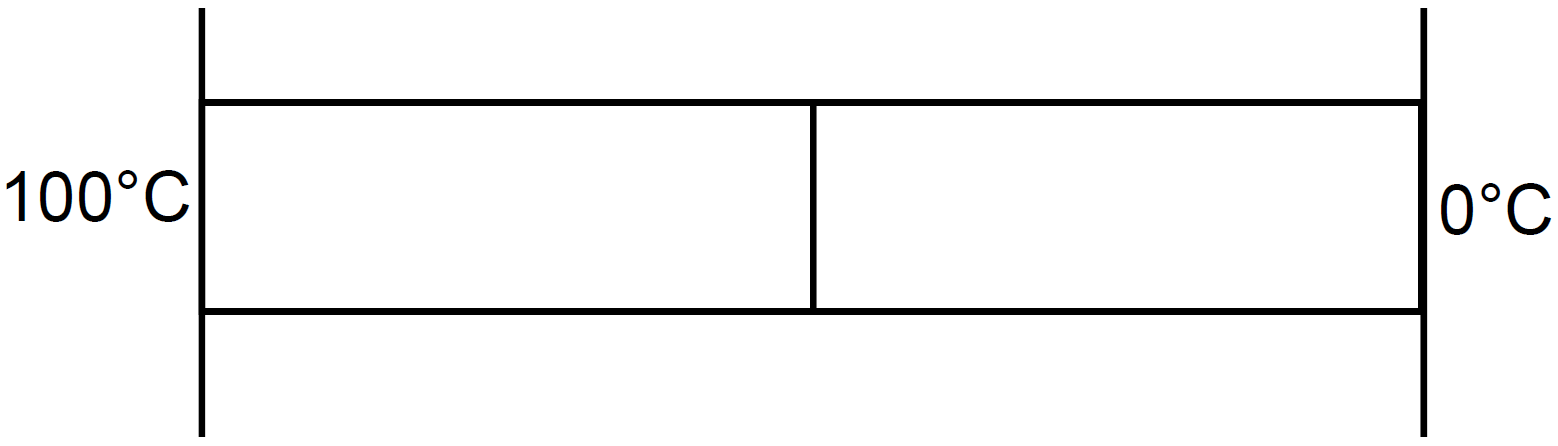
The two rods shown in figure, have identical geometrical dimensions. They are in contact with two heat baths at temperatures 100°C and 0°C. The temperature of the junction is 70°C. Find the temperature of the junction if the rods are interchanged.

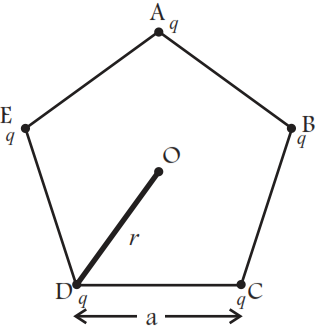
Five charges, q each are placed at the corners of a regular pentagon of side 'a' (Fig.).

  1.  
  1. What will be the electric field at O, the centre of the pentagon?
  2. What will be the electric field at O if the charge from one of the corners (say A) is removed?
  3. What will be the electric field at O if the charge q at A is replaced by -q?
  1. How would your answer to (a) be affected if pentagon is replaced by n-sided regular polygon with charge q at each of its corners?
Solve the previous problem if the friction coefficient between the 2.0kg block and the plane below it is 0.5 and the plane below the 4.0kg block is frictionless.