Question
(i) Parallel rays are incident:
1. on regular surface and
2. on irregular surface. In what respect do reflected rays in (1) differ from those of (2)?
(ii) Write down four characteristics of image formed in a plane mirror.
Answer

(i) Parallel rays of light after reflection from a regular surface. goes in a particular direction while after reflection from irregular surface go in different directions.
(ii) Characteristics of Image formed by a Plane Mirror.
(a) Image is of the same size as that of object.
(b) Image is laterally inverted.
(c) It is upright.
(d) It is virtual.
(e) Image formed is as far behind the mirror as the object in front of the mirror.

Need a full question paper?

Generate a complete, print-ready paper with questions like this in minutes — across 16+ boards, with answer keys.

Start Generating Free

Similar questions

(a) What do you understand by the term quantity of electric charge?
(b) State SI unit of electric charge and define it.
(c) How many electrons constitute one unit electric charge in SI system?
A boy is standing in front of a plane mirror at a distance of 3 m from it.
(i) What is the distance between the boy and his image?
(ii) If the boy moves 1 m backward, find the distance between the image and the boy.
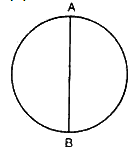
A circular cycle track has a circumstance of 314 m with AB as one of its diameter. A cyclist travels from A to B along the circular path with a velocity of constant magnitude 15. 7 m/ s. Find :
(a) The distance moved by the cyclist.
(b) The displacement of the cyclist if AB represents north-south direction .
(c) The average velocity of the cyclist.
(a) What do you understand by the term lateral inversion?
(b) A printed card has letters PHYSICS. By drawing the diagram show the appearance of the letters. (No ray diagram is required).
A solid weighs 1.5 kgf in air and 0.9 kgf in a liquid of density $1.2 \times 10^3 kg m ^{-3}$. Calculate R. D. of solid.
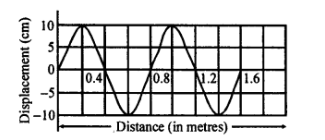
The diagram given below shows a displacement distance graph of a wave. If the velocity of wave is $160 ms-1$, calculate
1. wavelength
2. frequency
3. amplitude.
Image
How does negative error arise in the instrument?
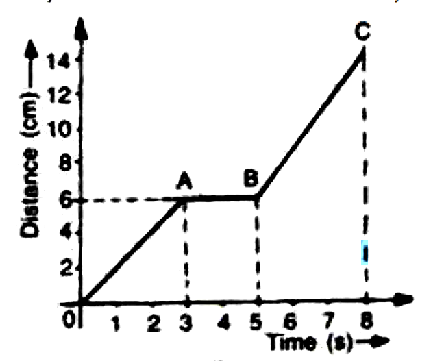
In figure the position of a body times is shown . Calculate the speed of the body as it moves from 0 to A, A to B, B to C and i ts average speed .
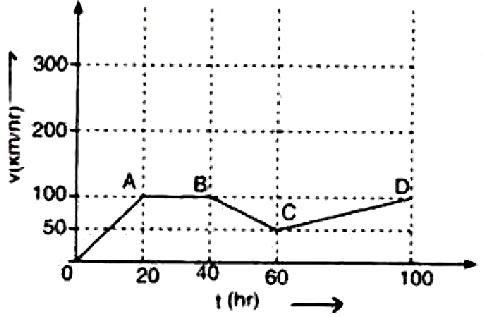
Figure represents graphically the velocity of a car moving along a straight road over a period of 100 hours.

Calculate the acceleration along AB and the retardation along BC.
How does the atmospheric pressure change with altitude? Draw an approximate graph to show this variation.