MCQ
Identify the combination which is not a series connection.
- AResistance box
- BDecorative bulbs
- CFuses
- DDomestic appliances
Explanation:
Domestic appliances in a house are connected in parallel combinations, and not in series combinations. This arrangement is done so that each of the appliances can switched on and off independently, which is essential in a house’s wiring.
Generate a complete, print-ready paper with questions like this in minutes — across 16+ boards, with answer keys.
A 4μF conductor is charged to 400 volts and then its plates are joined through a resistance of 1kΩ. The heat produced in the resistance is
|
(a) 0.16 J |
(b) 1.28 J |
(c) 0.64 J |
(d) 0.32 J |
Assertion : Radio waves can be polarised.
Reason : Sound waves in air are longitudinal in nature.
|
(a) If both assertion and reason are true and the reason is the correct explanation of the assertion. |
|
(b) If both assertion and reason are true but reason is not the correct explanation of the assertion. |
|
(c) If assertion is true but reason is false. |
|
(d) If the assertion and reason both are false. |
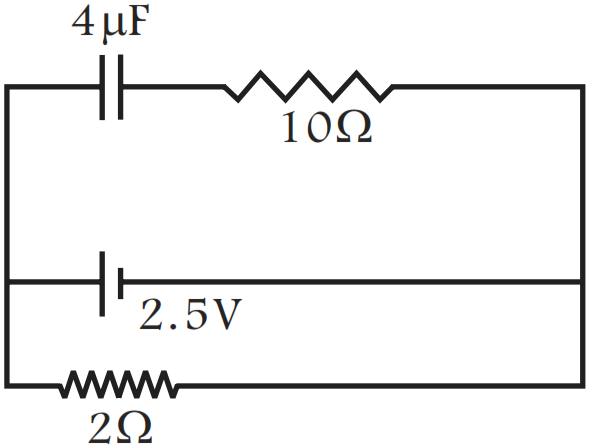
The output in the circuit of figure is taken across a capacitor. It is as shown in figure

(a)

|
(b)

|
(c)

|
(d)

|