MCQ
Identify the correct order
  • A
    $sec^{-1}(-2) < sec^{-1}(-1) < sec^{-1}(1) < sec^{-1}(2)$
  • B
    $sec^{-1}(2) < sec^{-1}(1) < sec^{-1}(-1) < sec^{-1}(-2)$
  • C
    $sec^{-1}(1) < sec^{-1}(-1) < sec^{-1}(2) < sec^{-1}(-2)$
  • $sec^{-1}(1) < sec^{-1}(2) < sec^{-1}(-2) < sec^{-1}(-1)$
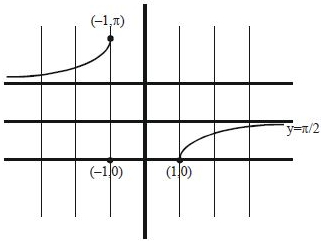
Answer

Correct option: D.
$sec^{-1}(1) < sec^{-1}(2) < sec^{-1}(-2) < sec^{-1}(-1)$
d
abvious from figure

$\sec ^{-1}(1)<\sec ^{-1}(2)<\sec ^{-1}(-2)<\sec ^{-1}(-1)$

Need a full question paper?

Generate a complete, print-ready paper with questions like this in minutes — across 16+ boards, with answer keys.

Start Generating Free

Similar questions

Which of the following equation is a linear differential equation of order 3?
[Note: The original question asks for linear equation, but it should be linear differential equation]:
If from Lagrange's mean value theorem, we have $\text{f}\ '(\text{x}_1)=\frac{\text{f}(\text{b})-\text{f}(\text{a})}{\text{b}-\text{a}},$ then :
$\mathop {Lim}\limits_{k \to 0} \,\,\frac{1}{k}\int\limits_0^k {{{(1 + \sin 2x)}^{\frac{1}{x}}}dx} $
If $\vec{\text{a}},\ \vec{\text{b}},\ \vec{\text{c}}$ are three non $-$ zero vectors, no two of which are collinear and the vector $\vec{\text{a}}+\vec{\text{b}}$ is collinear with $\vec{\text{c}}$, $\vec{\text{b}}+\vec{\text{c}}$ is collinear with $\vec{\text{a}}$, then $\vec{\text{a}}+\vec{\text{b}}+\vec{\text{c}}=$
If A is a singular matrix, then adj A is.
${d \over {dx}}\left( {{{\tan }^{ - 1}}\sqrt {{{1 + \cos {x \over 2}} \over {1 - \cos {x \over 2}}}} } \right)$ is equal to
If $A$ and $B$ are square matrices of order $n \times n$ such that, $A^2− B^2= (A − B)(A + B),$ then of the following will always be true?
In an entrance test there are multiple choice questions. There are four possible answers to each question of which one is correct. The probability that a student knows the answer to a question is $90\%$. If he gets the correct answer to a question, then the probability that he was guessing, is
The system of equations $x + y + z = 6$, $x + 2y + 3z = 10,x + 2y + \lambda z = \mu $, has no solution for
The solution of the equation $\frac{{dy}}{{dx}} = \frac{{{y^2} - y - 2}}{{{x^2} + 2x - 3}}$ is