MCQ
Identify the correct sequence for True and False

$(I)$ Only compounds with chiral centers can be optically active

$(II)$ Absence of elements of symmetry is the reason for a molecule's optical activity

$(II)$ All organic compounds contain carbon & hydrogen

$(IV)$ Different cannonical forms of a molecule represent the actual structures of a molecule which has resonace in it

  • A
    $TTFT$
  • $FFFF$
  • C
    $TTTT$
  • D
    $TTFF$

Answer

Correct option: B.
$FFFF$
b
$(I)$ A compound may be optically activeeven in absence of a chiral centre

$(II)$ Optical activity is due to different rotation of plane polarised light by the moleucle. Absence of symmetry is not the reason for optical activity.

$(III)$ Not all organic compounds may contain hydrogen

$(IV)$ Cannonical forms are not a ctual structures; they are the most suitable representations of the molecule

Need a full question paper?

Generate a complete, print-ready paper with questions like this in minutes — across 16+ boards, with answer keys.

Start Generating Free

Similar questions

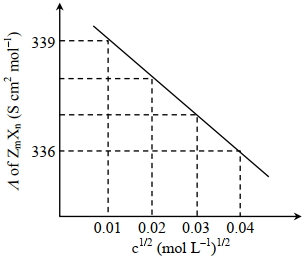
Consider the strong electrolytes $Z _{ m } X _{ n }, U _{ m } Y _{ p }$ and $V _{ m } X _{ n }$. Limiting molar conductivity $\left(\Lambda^0\right)$ of $U _{ m } Y _{ p }$ and $V _{ m } X _{ n }$ are $250$ and $440 S cm ^2 mol ^{-1}$, respectively. The value of $( m + n + p )$ is . . . . .Given:

$Ion$ $Z ^{ n +}$ $Z ^{ P +}$ $Z ^{ n +}$ $Z ^{ m +}$ $Z ^{ m +}$
$\lambda^0\left( S cm ^2 mol ^{-1}\right)$ $50.0$ $25.0$ $100.0$ $80.0$ $100.0$

$\lambda^0$ is the limiting molar conductivity of ions

The plot of molar conductivity $(4)$ of $Z _{ m } X _{ n } v s c ^{1 / 2}$ is given below.

Super are derived from compounds of
Which of the following are formed by xenon?
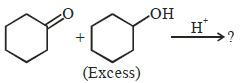
What is the major product of the following reaction
The complex compounds which result from the coordination of carbon monoxide are known as
The product of reaction when
Image
Match List $I$ with List $II$

LIST-$I$ LIST-$I$
  $A$.Glucose/NaHCO3/$\Delta$ $I$.Gluconic acid
$B$.Glucose/HNO3 $II$. No reaction
$C$.Glucose/HI/ $\Delta$ $III$. n-hexane
$D$. Glucose/Bromine [water] $IV$. Saccharic acid

Choose the correct answer from the options given below:

The compound $\mathrm{C}_{7} \mathrm{H}_{8}$ undergoes the following reactions:

$\mathrm{C}_{7} \mathrm{H}_{8} \stackrel{3 \mathrm{Cl}_{2} / \Delta}{\longrightarrow} \mathrm{A} \stackrel{\mathrm{Br}_{2} / \mathrm{Fe}}{\rightarrow} \mathrm{B} \stackrel{\mathrm{Zn} / \mathrm{HCl}}{\rightarrow} \mathrm{C}$

The product '$C$' is

Select the correct code of $TRUE$ and $FA LSE$ for given statements

$(a)$ Peroxide ion as well as dioxygen molecule both are paramagnetic  species
$(b)$ In set of isomers, $[Cr(H_2O)_6]Cl_3$ and $[CrCl(H_2O) _5]Cl_2 . H_2O,$ both compounds can easily loose water molecule on treatment with cone. $H_2SO_4$
$(c)$ During transformation $NO \to NO^+$ , bond length and magnetic  behaviour decreases 
$(d)$ An ether is more volatile than alcohol both having same molecular formula

The compound that undergoes decarboxylation most readily under mild condition is :