Question
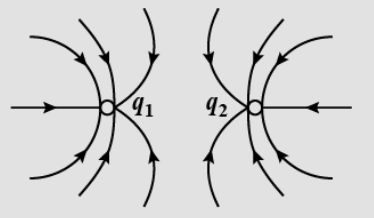
Identify the correct statement about the charges $q_{1​}$ and $q_{2}$

Answer

The filed of lines is outward from the positive charge and inward to the negative charge.
Here the field of lines is towards the charges $q_{1​}$ and $q_{2​}$. Thus, both charges are negative.

Need a full question paper?

Generate a complete, print-ready paper with questions like this in minutes — across 16+ boards, with answer keys.
Start Generating Free

Similar questions

If $\mathrm{I}_0$ is the intensity of the principal maximum in the single slit diffraction pattern, then what will be its intensity when the slit width is doubled
The angular frequency of emf wave will be $($in $\frac{\text{rad}}{\text{s}})$
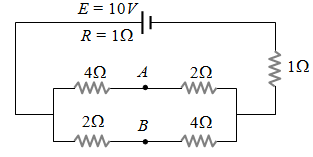
In the circuit shown below, the cell has an $e.m.f.$ of $10 V$ and internal resistance of $1$ ohm. The other resistances are shown in the figure. The potential difference  $V_A-V_B$ is
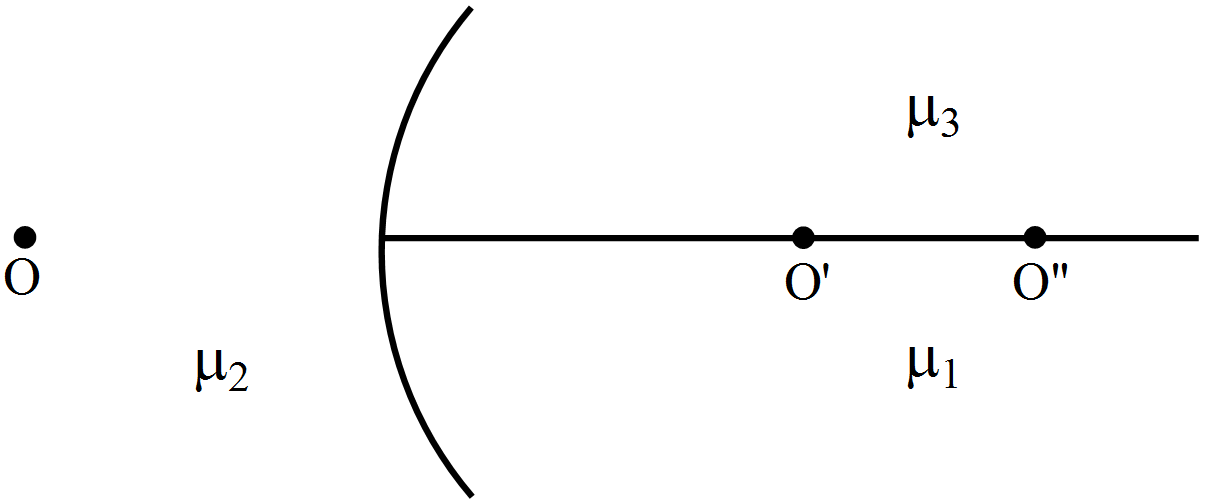
Three transparent media of refractive indices $\mu_1,\mu_2$ and $\mu_3.$ A point object $O$ is placed in the medium $\mu_2.$ If the entire medium on the right of the spherical surface has refractive index $\mu_1,$ the image forms at $O\ '$. If this entire medium has refractive index $\mu_3,$ the image forms at $O"$. In the situation shown:
The mean age of neutron is :
Consider a current carrying wire (current I) in the shape of a circle. Note that as the current progresses along the wire, the direction of j (current density) changes in an exact manner, while the current I remain unaffected. The agent that is essentially responsible for is:
Particles which can be added to the nucleus of an atom without changing its chemical properties are called:
Which of the following is true (a) Common base transistor is commonly used because current gain is maximum(b) Common emitter is commonly used because current gain is maximum(c) Common collector is commonly used because current gain is maximum (d) Common emitter is the least used transistor


Two wires of equal diameters, of resistivities $\rho_1 $ and $\rho_2$ and lengths $\mathrm{I}_1$ and $\mathrm{I}_2$, respectively, are joined in series. The equivalent resistivity of the combination is
To convert galvanometer into voltmeter one should connect: