Question
The angular frequency of emf wave will be $($in $\frac{\text{rad}}{\text{s}})$

Answer

Frequency of wave $f = 40 \times 106 Hz$
Angular frequency, $\omega=2\pi\text{v}$
$\omega=2\pi\times40\times10^6$
$\Rightarrow\omega=8\pi\times10^7\frac{\text{rad}}{\text{s}}$

Need a full question paper?

Generate a complete, print-ready paper with questions like this in minutes — across 16+ boards, with answer keys.
Start Generating Free

Similar questions

(1): The dielectric medium between the plates of a parallel plate capacitor lowers the potential difference between the plates without a battery.
(2): The maximum electric field that a dielectric can withstand without causing it to break down is dielectric strength.
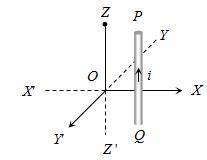
A vertical wire kept in $Z-X$ plane carries a current from $Q$ to $P ($see figure$).$ The magnetic field due to current will have the direction at the origin $O$ along
A galvanometer of resistance $36 W$ is changed into an ammeter by using a shunt of $4 W$. The fraction $f_0$ of total current passing through the galvanometer is
A photo sensitive metal is not emitting photo-electrons when irradiated. It will do so when threshold is crossed. To cross the threshold we need to increase?
The focal length of a concave mirror is 10 cm. On placing an object at 10 cm in front of the mirror, its image will be formed:
An electron is moving along positive x-axis. To get it moving on an anticlockwise circular path in x-y plane, a magnetic filed is applied(a) Along positive y-axis(b) Along positive z-axis(c) Along negative y-axis(d) Along negative z-axis
   
   
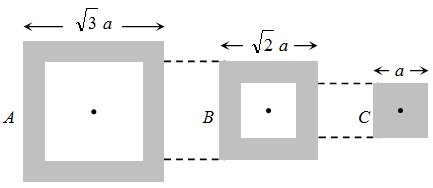
Following figure shows cross$-$sections through three long conductors of the same length and material, with square cross$-$section of edge lengths as shown. Conductor $B$ will fit snugly within conductor $A,$ and conductor $C$ will fit snugly within conductor $B$. Relationship between their end to end resistance is
.
An astronomical refractive telescope has an objective of focal length $20m$ and an eyepiece of focal length $2\ cm.$
Hubble's law is related with (a) Comet(b) Speed of galaxy (c) Black hole(d) Planetary motion
       
A photon will have less energy, if its: