Question
Identify the following electromagnetic radiations as per the frequencies given below$:$
  1. $10^{20}\ Hz$
  2. $10^9\ Hz$
  3. $10^{11}\ Hz$
Write one application of each.

Answer

  1. $10^{20}\ Hz \rightarrow γ-$radiation,
Application: For treatment of cancer.
  1. $10^9\ Hz \rightarrow$ Radio waves,
Application: For broadcasting radio-programmes to long distances.
  1. $10^{11}Hz \rightarrow$ Microwaves,
Application: For cooking in microwave oven.

Need a full question paper?

Generate a complete, print-ready paper with questions like this in minutes — across 16+ boards, with answer keys.
Start Generating Free

Similar questions

A uniform conducting wire of length $12a$ and resistance $R$ is wound up as a current carrying coil in the shape of:
  1. An equilateral triangle of side $a.$
  2. A square of sides $a.$
  3. A regular hexagon of sides $a.$ The coil is connected to a voltage source $V_0.$ Find the magnetic moment of the coils in each case.
A cylindrical capacitor has two co $-$ axial cylinders of length $15\ cm$ and radii $1.5\ cm$ and $1.4\ cm$. The outer cylinder isearthed and the inner cylinder is given a charge of $3.5\mu C$. Determine the capacitance of the system and the potential of the inner cylinder. Neglect end effects $($i.e., bending of field lines at the ends$).$
What is transformer? What is its transformation ratio ?
An object is placed at $ (i) 10 \ cm, (ii) 5 \ cm$ in front of a concave mirror of radius of curvature $15 \ cm$. Find the position, nature, and magnification of the image in each case.
A radioactive isotope is being produced at a constant rate $\frac{\text{dN}}{\text{dt}}=\text{R}$ in an experiment. The isotope has a half-life $\text{t}_{\frac{1}2{}}.$ Show that after a time $\text{t}>>\text{t}_{\frac{1}{2}},$ the number of active nuclei will become constant. Find the value of this constant.
A particle moves in a circle of radius 1.0cm at a speed given by v = 2.0t where v is in cm/s and t in seconds.
  1. Find the radial acceleration of the particle at t = 1s.
  2. Find the tangential acceleration at t = 1s.
  3. Find the magnitude of the acceleration at t = 1s.
A circular loop of radius r carrying a current i is held at the centre of another circular loop of radius R(>> r) carrying a current I. The plane of the smaller loop makes an angle of 30° with that of the larger loop. If the smaller loop is held fixed in this position by applying a single force at a point on its periphery, what would be the minimum magnitude of this force?
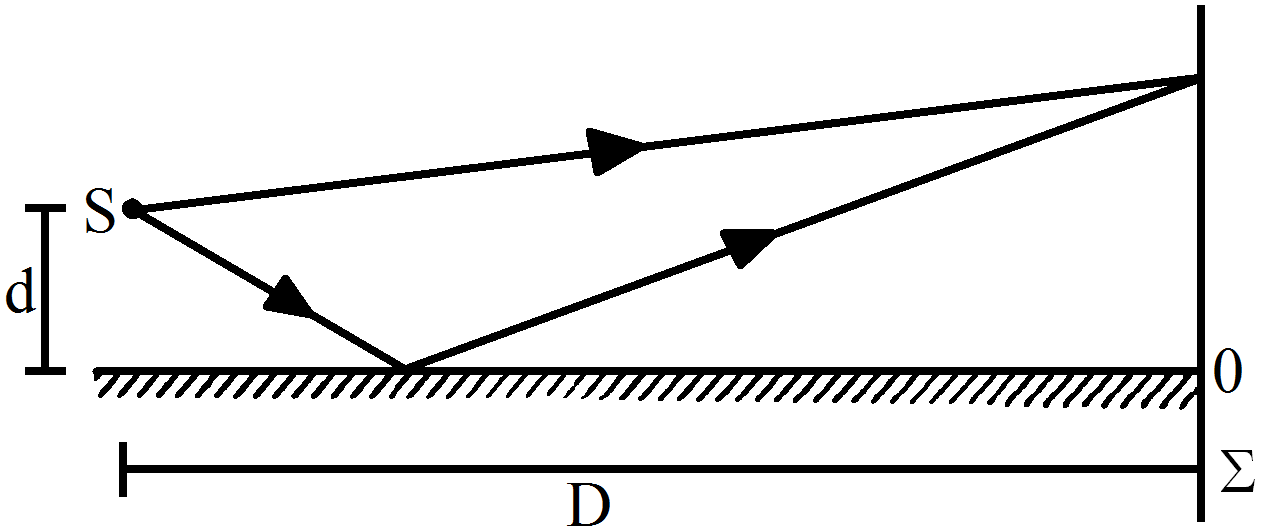
A narrow slit S transmitting light of wavelength $\lambda$ is placed a distance d above a large plane mirror as shown in figure (17-E1). The light coming directly from the slit and that coming after the reflection interfere at a screen $\sum$ placed at a distance D from the slit.
  1. What will be the intensity at a point just above the mirror, i.e., just above O?
  2. At what distance from 0 does the first maximum occur?
Four point charges $q_A = 2 \mu C, q_B = –5 \mu C, q_C = 2 \mu C,$ and $q_D = –5 \mu C$ are located at the corners of a square $\text{ABCD}$ of side $10 \ cm$. What is the force on a charge of $1 \mu C$ placed at the centre of the square?
Explain how the scattering experiment can be analyzed in detail from Rutherford's nuclear model.