Question
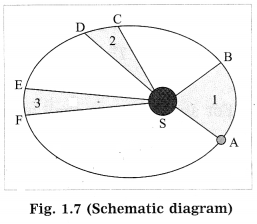
Identify the law shown in Fig. 1.7 and state the three respective laws. (Practice Activity Sheet –3)
Maharashtra Board Class 10 Science Solutions Part 1 Chapter 1 Gravitation 30

Answer

(a) From the given description we understand Kepler ’s three laws.
(b) Kepler ’s law of areas: The line joining the planet and the Sun sweeps equal areas in equal intervals of time.
(c) Kepler’s law of periods: The square of the period of revolution or a planet around the Sun is directly proportional to the cube of the mean distance of the planet from the Sun.

Need a full question paper?

Generate a complete, print-ready paper with questions like this in minutes — across 16+ boards, with answer keys.
Start Generating Free

Similar questions

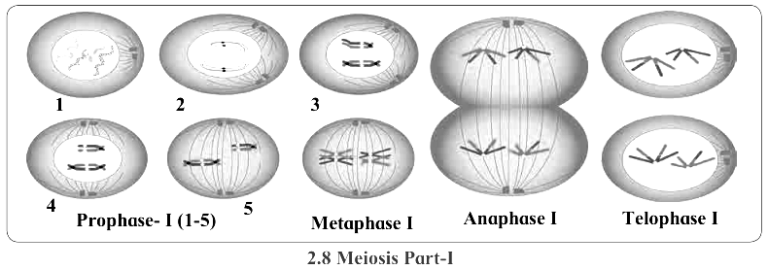
Observe the diagrams and answer the following questions.
Image
Image

(a) Which peculiarity do you observe in the figure of Metaphase-I of meiosis ?
(b) What is the important difference between Telophase-I and Telophase-II of meiosis?
(c) Which figure shows phenomena of crossing over?
Complete the chart:
Different problems occur with disasters. In the concept map different effects are mentioned. Read it and fill the blank places.
While conducting experiments to study the effect of various stimuli on the plants, it was observed that the roots of a plant X grow and bend towards two stimuli A and B but bend away from a third stimulus C. The stem of the plant X, however, bends away from stimuli A and B but bends towards the stimulus C. The stimulus B is known to act on the roots due to too much weight of the earth. Keeping these points in mind, answer the following question:
  1. What could stimulus A be?
  2. Name the stimulus B.
  3. What could stimulus C be?
  4. The branches of a fallen tree in a forest grow straight up in response to two stimuli. What could be these two stimuli out of A, B and C? Also name these two stimuli.
Consider the following organic compounds:
$CH_3OH, C_2H_5OH, CH_3COCH_3, CH_3COOH, C_2H_5COOH, C_4H_9COOC_2H_5, CH_4, C_2H_6, CH_3CHO, HCHO$
Out of these compounds:
  1. Which compound is most likely to be sweet-smelling?
  2. Which compound on treatment with conc. $H_2SO_4 $ at $170^\circ C$ forms an alkene?
  3. Which compound on repeated chlorination forms chloroform?
  4. Which compound is added to alcohol to denature it?
  5. Which compound is a constituent of vinegar?
  6. Which compound is used to sterilise wounds and syringes?
An object is placed at a distance of 10cm from a concave mirror of focal length 20cm.
  1. Draw a ray diagram for the formation of image.
  2. Calculate the image distance.
  3. State two characteristics of the image formed.
Observe the pictures given and discuss the characters observed.
Image
What is esterification and give its uses?
Write short note: Blue Revolution.
The flask-shaped organ A at the centre of a flower is surrounded by a number of little stalks B having swollen tops which lie just inside the ring of petals.
  1. Name A. What are the various parts of A?
  2. Which part of A contains gametes?
  3. Name B. What is the swollen top of B known as?
  4. What does the swollen top of b contain?
  5. Out of A and B, which one is (i) male part, and (ii) female part of the flower?
Write short notes on the following: Anodizing.
(OR)
Identify the process shown in the above diagram and explain it in brief.
Image