Question
  1. Identify the logic gates marked P and Q in the given logic circuit.
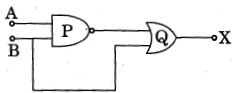
  1. Write down the output at X for the inputs A = 0, B = 0 and A = 1, B = 1.

Answer

  1. P: NAND gate.
Q: OR gate.
  1. Inputs A = 0 and B = 0 then output X=1
Inputs A = 1 and B = 1 then output X = 1.

Need a full question paper?

Generate a complete, print-ready paper with questions like this in minutes — across 16+ boards, with answer keys.
Start Generating Free

Similar questions

Suppose you are given a chance to repeat the alpha-particle scattering experiment using a thin sheet of solid hydorgen in place of the gold foil. (Hydrogen is a solid at temperatures below 14 K.) What results do you expect?
State the underlying principle of a cyclotron. Write briefly how this machine is used to accelerate charged particles to high energies.
In order to have a current in a long wire, it should be connected to a battery or some such device. Can we obtain the magnetic due to a straight, long wire by using Ampere's law without mentioning this other part of the circuit?
A cell whose electromotive force is 2 volt and internal resistance 0.1 is joined with an external resistance of 3,9 . Find the terminal voltage of the cell.
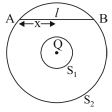
Calculate the electric flux passing through the spheres $S_1$ and $S_2$ shown in the figure. The linear charge density of the wire $A B$ shown in the figure is $\lambda=K x$ where $x=$ distance from the end $A$ of the wire measured along its length.
Image
Why is the luminous efficiency small for a filament bulb as compared to a mercury vapour lamp?
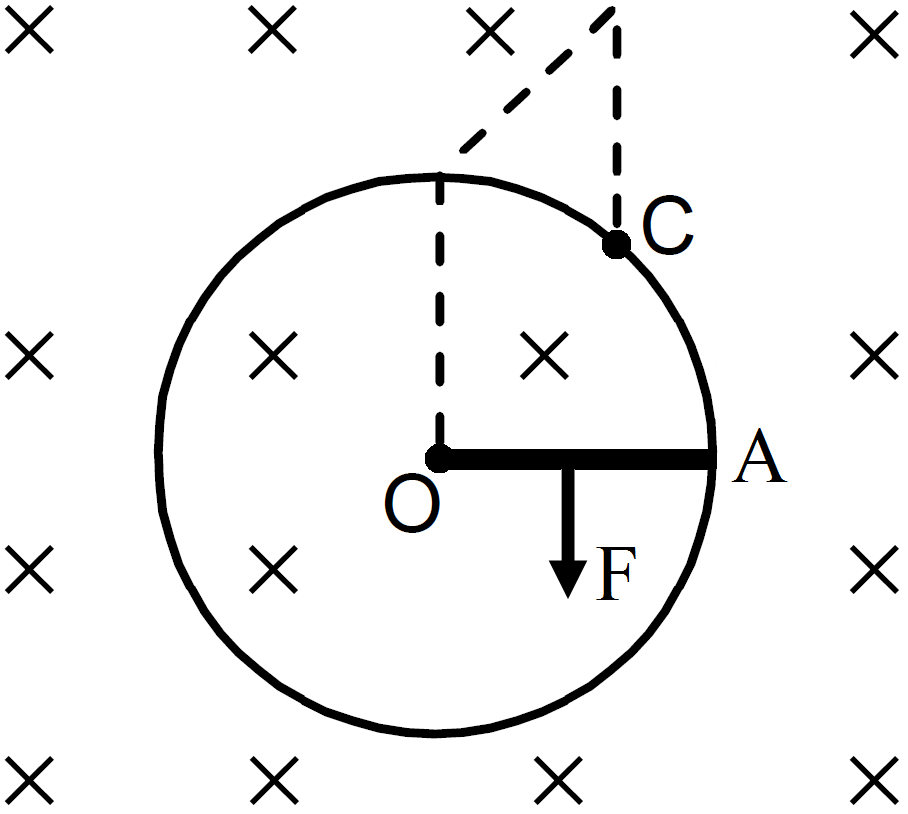
Figure shows a conducting circular loop of radius a placed in a uniform, perpendicular magnetic field B. A thick metal rod OA is pivoted at the centre O. The other end of the rod touches the loop at A. The centre O and a fixed point C on the loop are connected by a wire OC of resistance R. A force is applied at the middle point of the rod OA perpendicularly, so that the rod rotates clockwise at a uniform angular velocity $\omega.$ Find the force.
The decay constant of $\text{ }^{197}_{80}\text{Hg} ($electron capture to $\text{ }^{197}_{79}\text{Au})$ is $1.8 \times 10^{-4} S^{-1}.$
  1. What is the half-life$?$
  2. What is the average-life$?$
  3. How much time will it take to convert $25\%$ of this isotope of mercury into gold$?$
The magnetic properties of the different materials A, B and C are shown in the following table:
Material Permeability Susceptibility Temperature dependence of susceptibility.
A Low positive Small but negative Independent of temperature
B High Very high 1 Susceptibility decreases with temperature
C Greater than 1  Small but positive Decreases with temperature
Which of the above three materials should be used for making an electromagnet and why?
Define electric field strength. Is it a vector or a scalar quantity?