Question
Suppose you are given a chance to repeat the alpha-particle scattering experiment using a thin sheet of solid hydorgen in place of the gold foil. (Hydrogen is a solid at temperatures below 14 K.) What results do you expect?

Answer

Proton is nucleus of hydrogen atom. Its mass is 1.67 ×10 -27 kg while mass of incident a-particle is 6.64 ×10⁻²⁷ kg. Since mass of scattered particle is more than the nucleus of target (proton), therefore, a-particle will not returned even in direct collision. 
It is analogous to the football collides with the tenis ball in the rest. 
Therefore scattering will not be able at large angles.

Need a full question paper?

Generate a complete, print-ready paper with questions like this in minutes — across 16+ boards, with answer keys.
Start Generating Free

Similar questions

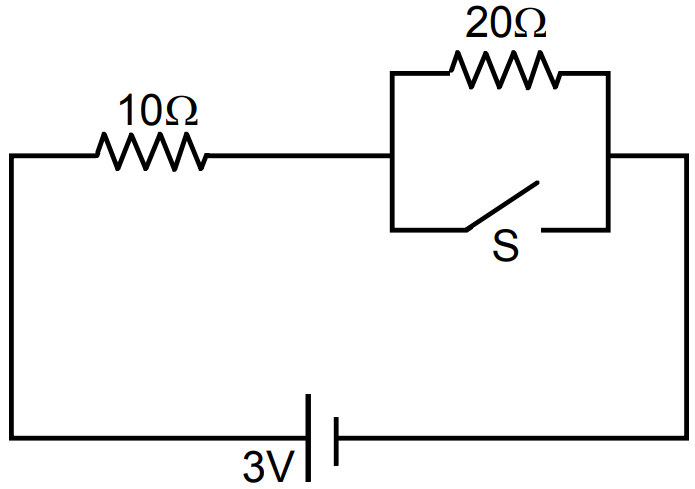
Consider the circuit shown in figure. Find the current through the $10\Omega$ resistor when the switch S is (a) Open (b) Closed.
Discuss the intensity of transmitted light when a polaroid sheet is rotated between two crossed polaroids?
In order to have a current in a long wire, it should be connected to a battery or some such device. Can we obtain the magnetic due to a straight, long wire by using Ampere's law without mentioning this other part of the circuit?
Draw a circuit diagram using a metre bridge and write the necessary mathematical relation used to determine the value of an unknown resistance. Why cannot such an arrangement be used for measuring very low resistances?
Half-life time of a radioactive element is 10 years. In how much time it will be left (1/16)th of its original mass ?
With the help of suitable diagram explain the real depth and apparent depth.
Draw 3 equipotential surfaces corresponding to a field that uniformly increases in magnitude but remains constant along Z-direction. How are these surfaces different from that of a constant electric field along Z-direction?
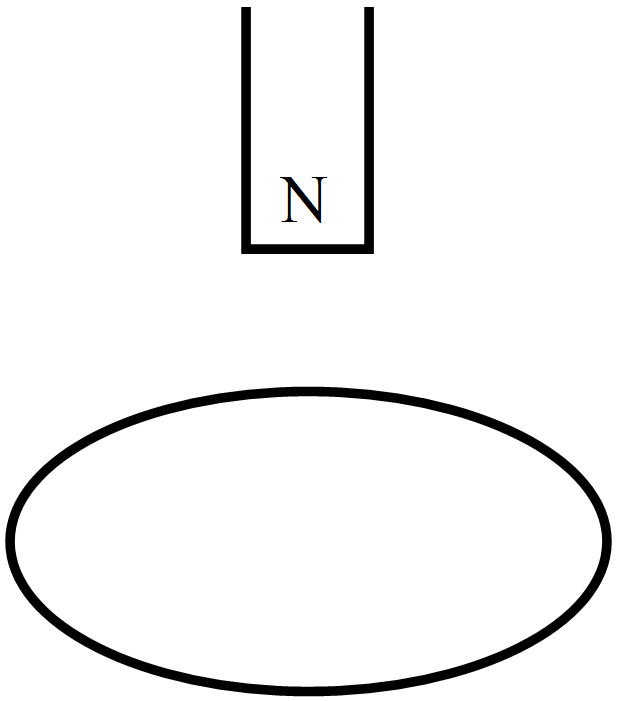
The north pole of a magnet is brought down along the axis of a horizontal circular coil. As a result, the flux through the coil changes from 0.35 weber to 0.86 weber in an interval of half a second. Find the average emf induced during this period. Is the induced current clockwise or anticlockwise as you look into the coil from the side of the magnet?
Is there any lower limit to the electric force between two particles placed at a separation of 1cm ?
Find the greatest length of an organ pipe open at both ends that will have its fundamental frequency in the normal hearing range (20Hz-20,000Hz). Speed of sound in air = 340m/s.