MCQ
Identify the pairs which are not of isotopes?
  • A
    $^{13}_6\text{X},\ ^{13}_6\text{Y}.$
  • B
    $^{35}_{17}\text{X},\ ^{37}_{17}\text{Y}.$
  • C
    $^{14}_6\text{X},\ ^{14}_7\text{Y}.$
  • D
    $^{8}_4\text{X},\ ^{8}_5\text{Y}.$

Answer

  1. $^{14}_6\text{X},\ ^{14}_7\text{Y}.$

  2. $^{8}_4\text{X},\ ^{8}_5\text{Y}.$

Explanation:

Isotopes have the same atomic number but different mass number.

$\therefore\ \Big(\ ^{14}_{6}\text{X},\ ^{14}_{7}\text{Y}\Big)$ and $\Big(\ ^8_4\text{X},\ ^8_5\text{Y}\Big)$ are not isotopes.

Need a full question paper?

Generate a complete, print-ready paper with questions like this in minutes — across 16+ boards, with answer keys.
Start Generating Free

Similar questions

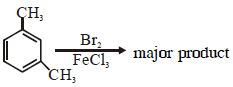
What is the major product of following reaction
In kjeldahl’s method, $CuS{O_4}$ acts as
A compound whose molecules are superimposable on their mirror images even through they contain an asymmetric carbon atom is called
The total number of cyclic isomers possible for a hydrocarbon with the molecular formula $\mathrm{C}_4 \mathrm{H}_6$ is
First ionization potential of Mg is less than that of:
Identify the incorrect statement
In which pair, or pairs, is the stronger bond found in the first species

$(a)$ $O_2^ - ,{O_2}$  $(b)$ ${N_2},N_2^ +$  $(c)$ $NO^+, NO^-$

If moving proton, dutron and alpha particle have same De-Broglie wave length then which is correct order of their kinetic energy
Write the $IUPAC$ name of  $\begin{array}{*{20}{c}}
  {\,\,\,\,H\,\,\,\,\,\,\,\,\,\,\,\,\,\,\,\,\,\,\,\,\,\,\,\,\,\,\,\,\,\,\,\,\,\,\,\,\,\,\,\,\,\,\,\,\,\,\,\,\,\,\,\,\,\,\,\,\,\,\,Br} \\ 
  {\,|\,\,\,\,\,\,\,\,\,\,\,\,\,\,\,\,\,\,\,\,\,\,\,\,\,\,\,\,\,\,\,\,\,\,\,\,\,\,\,\,\,\,\,\,\,\,\,\,\,\,\,\,\,\,\,\,\,\,\,\,\,\,\,\,\,|} \\ 
  {C{H_3} - C - C{H_2} - C{H_2} - C{H_2} - C - C{H_3}} \\ 
  {\,|\,\,\,\,\,\,\,\,\,\,\,\,\,\,\,\,\,\,\,\,\,\,\,\,\,\,\,\,\,\,\,\,\,\,\,\,\,\,\,\,\,\,\,\,\,\,\,\,\,\,\,\,\,\,\,\,\,\,\,\,\,\,\,\,\,\,|} \\ 
  {\,\,OH\,\,\,\,\,\,\,\,\,\,\,\,\,\,\,\,\,\,\,\,\,\,\,\,\,\,\,\,\,\,\,\,\,\,\,\,\,\,\,\,\,\,\,\,\,\,\,\,\,\,\,\,\,\,\,\,\,\,\,Br} 
\end{array}$
How many litres of water must be added to $1\,\, litre$ of an aqueous solution of $HCl$ with a $pH$ of $1$ to create an aqueous solution with $pH$ of $2$?.......$L$