MCQ
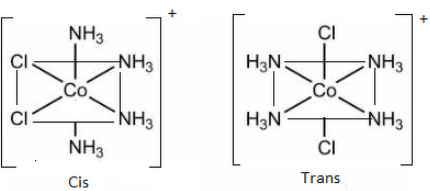
Identify the type of isomerism shown by [Co(NH3​)4​Cl2​]+:
  • A
    Geometrical cis, trans
  • B
    Geometrical fac, mer
  • C
    Optical
  • D
    None of the above

Answer

  1. Geometrical cis, trans

Explanation:

[Co(NH3​)4​Cl2​]+ will show cis, trans geometrical isomerism.
Need a full question paper?

Generate a complete, print-ready paper with questions like this in minutes — across 16+ boards, with answer keys.

Start Generating Free

Similar questions

On passing $C$ ampere of electricity through a electrolyte solution for $t$ second, $m$ gram metal deposits on cathode. The equivalent weight $E$ of the metal is
A reaction takes place in three steps with individual rate constant and activation energy,

  Rate constant Activation energy
Step $1$ $k_1$ $E_{a_1} = 180\,kJ /mol$
Step $2$ $k_2$ $E_{a_2} = 80\,kJ /mol$
Step $3$ $k_3$ $E_{a_3} = 50\,kJ /mol$

overall rate constant, $k = {\left( {\frac{{{k_1}{k_2}}}{{{k_3}}}} \right)^{2/3}}$ overall activation energy of the reaction will be ........ $kJ\,mol$

Catalyst $A$ reduces the activation energy for a reaction by $10\, k\,J\, mol ^{-1}$ at $300\, K$. The ratio of rate $\frac{ k _{ T }, \text { Catalysed }}{ k _{ T }, \text { Uncatalysed }}$ is $e ^{ x }$ [nearest integer $]$

[Assume theat the pre-exponential factor is same in both the cases.

Given $R =8.31 \,J\, K ^{-1} \,mol ^{-1}$ ]

Calculate emf of cell at $25^{\circ} C$

Cell notation : $M \left|\underset{0.01}{ M ^{2+}} \| \underset{0.0001}{ M ^{2+}}\right| M$

.........$V$ value of $E _{ Cell }^{o}$ is $4$ volt (Given $\frac{ RT }{ F }$ in $10=0.06$ )
An, example for a double salt is
Which of following can be prepared by Gabriel phthalimide reaction
State the oxidation number of carbonyl carbon in methanal and methanoic acid respectively:
Which of the following aldehydes is most reactive towards nucleophilic addition reactions
The metal capable of gaining as well as losing an electron is:
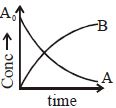
For the reaction, $A \to nB$. At the point of intersection of the two curves, the concentration of $B$ is given by .....