MCQ
Identify the wrong description of the above figures
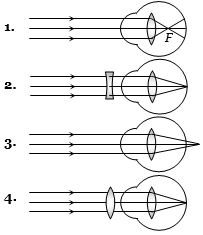
  • $1$ represents far-sightedness
  • B
    $2$ correction for short sightedness
  • C
    $3$ represents far sightedness
  • D
    $4$ correction for far-sightedness

Answer

Correct option: A.
$1$ represents far-sightedness
a
(a) In figure $1,$ parallel rays, that is, rays coming from infinity converge and focus before reaching the retina, hence the person is not able to see far objects, and is nearsighted.

Need a full question paper?

Generate a complete, print-ready paper with questions like this in minutes — across 16+ boards, with answer keys.
Start Generating Free

Similar questions

A molecule with a dipole moment p is placed in an electric field of strength E. Initially the dipole is aligned parallel to the field. If the dipole is to be rotated to be anti-parallel to the field, the work required to be done by an external agency is
The concept of stationary orbits was proposed by:
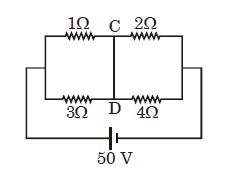
In the given circuit diagram, find the current passing through wire $CD$ (in ampere) 
Speed of an electron in Bohr's $7^{\text {th }}$ orbit for Hydrogen atom is $3.6 \times 10^6\,m / s$. The corresponding speed of the electron in $3^{\text {rd }}$ orbit, in $m / s$ is $........\times 10^6$
When a biconvex lens of glass having refractive index $1.47$ is dipped in a liquid, it acts as a plane sheet of glass. This implies that the liquid must have refractive index
In the uranium radioactive series, the initial nucleus is $_{92}{U^{238}}$ and the final nucleus is $_{82}P{b^{206}}$. When the uranium nucleus decays to lead, the number of $\alpha - $ particles emitted will be
Two identical dipoles each of magnetic moment $1.0\, A-m^2$ are placed at a separation of $2\,m$ with their axes perpendicular to each other. What is the magnetic field at a point midway between the dipoles ?
For an isosceles prism of angle $A$ and refractive index $\mu$, it is found that the angle of minimum deviation $\delta_m=A$. Which of the following options is/are correct?

[$A$] At minimum deviation, the incident angle $i_1$ and the refracting angle $r_1$ at the first refracting surface are related by $\mathrm{r}_1=\left(\mathrm{i}_1 / 2\right)$.

[$B$] For this prism the refractive index $\mu$ and the angle of prism $A$ are related as $A=\frac{1}{2} \cos ^{-1}(\mu / 2)$.

[$C$] For this prism, the emergent ray at the second surface will be tangential to the surface when the angle of incidence at the first surface is $i_1=\sin ^{-1}\left[\sin A \sqrt{4 \cos ^2 \frac{A}{2}-1}-\cos A\right]$.

[$D$] For the angle of incidence $i_1=A$, the ray inside the prism is parallel to the base of the prism.

A series $L C R$ circuit with $L=\frac{100}{\pi} \mathrm{mH}, C=\frac{10^{-3}}{\pi} \mathrm{F}$ and $R=10 \Omega$, is connected across an ac source of $220 \mathrm{~V}, 50 \mathrm{~Hz}$ supply. The power factor of the circuit would be___________.
A battery of $24$ cells, each of emf $1.5\, V$ and internal resistance $2\, \Omega$ is to be connected in order to send the maximum current through a $12 \,\Omega$ resistor. The correct arrangement of cells will be