MCQ
If $2\vec a + 3\vec b + \vec c = \vec 0$, then  $\vec a \times \vec b + \vec b \times \vec c + \vec c \times \vec a$ is equal to
  • A
    $6\left( {\vec b \times \vec c} \right)$
  • $3\left( {\vec b \times \vec c} \right)$
  • C
    $2\left( {\vec b \times \vec c} \right)$
  • D
    $\vec 0$

Answer

Correct option: B.
$3\left( {\vec b \times \vec c} \right)$
b
Given, $2\overrightarrow a  + 3\overrightarrow b  + \overrightarrow c  = \overrightarrow 0 $

$ \Rightarrow 2\overrightarrow a  + 3\overrightarrow b  =  - \overrightarrow c $

Taking cross product with $\overrightarrow{\mathrm{a}}$ and $\overrightarrow{\mathrm{b}}$ respectively, we get

$2(\overrightarrow a  \times \overrightarrow a ) + 3(\overrightarrow a  \times \overrightarrow b ) =  - \overrightarrow a  \times \overrightarrow c $

$ \Rightarrow \quad 3(\overrightarrow a  \times \overrightarrow b ) = \overrightarrow c  \times \overrightarrow a $      .......$(i)$

and $\quad 2(\overrightarrow{\mathrm{b}} \times \overrightarrow{\mathrm{a}})+3(\overrightarrow{\mathrm{b}} \times \overrightarrow{\mathrm{b}})=-\overrightarrow{\mathrm{b}} \times \overrightarrow{\mathrm{c}}$

$ \Rightarrow \quad 2(\overrightarrow a  \times \overrightarrow b ) = \overrightarrow b  \times \overrightarrow c $      .....$(ii)$

Now, $\vec{a} \times \vec{b}+\vec{b} \times \vec{c}+\vec{c} \times \vec{a}$

$ = \overrightarrow a  \times \overrightarrow b  + \overrightarrow b  \times \overrightarrow c  + 3(\overrightarrow a  \times \overrightarrow b )\quad $      [using Eq. $(i)$] 

$ = 4(\overrightarrow a  \times \overrightarrow b ) + \overrightarrow b  \times \overrightarrow c $

$ = 2(\overrightarrow b  \times \overrightarrow c ) + \overrightarrow b  \times \overrightarrow c $           [using Eq. $(ii)$] 

$ = 3(\overrightarrow b  \times \overrightarrow c )$
Need a full question paper?

Generate a complete, print-ready paper with questions like this in minutes — across 16+ boards, with answer keys.

Start Generating Free

Similar questions

The coefficients $\mathrm{a}, \mathrm{b}, \mathrm{c}$ in the quadratic equation $a x^2+b x+c=0$ are chosen from the set $\{1,2,3,4,5,6,7,8\}$. The probability of this equation having repeated roots is :
If $\int {\frac{{\cos e{c^2}x}}{{{{\left( {\cos ec\,x\, + \,\cot \,x} \right)}^{\frac{9}{2}}}}}\,dx} $ = ${\left( {\cos ec\,x\, - \,\cot \,x} \right)^{\frac{7}{2}}}\left( {\frac{1}{\alpha } + \frac{{{{\left( {\cos ec\,x\, - \,\cot \,x} \right)}^2}}}{{11}}} \right) + \,C$ (where $C$ is constant of integration and $\alpha \in N)$ , then $\alpha $ is 
Area lying first quadrant and bounded by the circle $x^2 + y^2 = 4$ and the line $x = 0$ and $x = 2,$ is:
Force $3i + 2j + 5k$ and $2i + j - 3k$ are acting on a particle and displace it from the point $2i - j - 3k$ to the point $4i - 3j + 7k,$ then work done by the force is ............... $\mathrm{unit}$
Let $\overrightarrow{\mathrm{a}}$ and $\overrightarrow{\mathrm{b}}$ be two vectors such that $|2 \vec{a}+3 \vec{b}|=|3 \vec{a}+\vec{b}|$ and the angle between $\vec{a}$ and $\vec{b}$ is $60^{\circ}$. If $\frac{1}{8} \vec{a}$ is a unit vector, then $|\vec{b}|$ is equal to :
Which of the following holds true for a vector quantity:
The interval in which the function $\mathrm{f}(\mathrm{x})=\mathrm{x}^{\mathrm{x}}, \mathrm{x}>0$, is strictly increasing is
$\int_{}^{} {\frac{{dx}}{{{e^{ - 2x}}{{({e^{2x}} + 1)}^2}}} = } $
Region represented by $x \geq 0, y \geq 0$ is
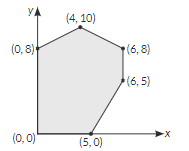
The feasible region for an LPP is shown below: Let $z=3 x-4 y$ be the objective function. Minimum of $z$ occurs at
Image