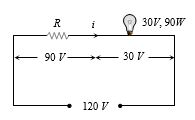
If a $30\, V$, $90\, W$ bulb is to be worked on a $120\, V$ line, a resistance of how many ohms should be connected in series with the bulb ............... $ohm$
Medium


Download our appand get started for free
Experience the future of education. Simply download our apps or reach out to us for more information. Let's shape the future of learning together!No signup needed.*
Similar Questions
- 1In the circuit element given here, if the potential at point $B$, $V_B = 0$, then the potentials of $A$ and $D$ are given asView Solution

- 2The resistivity of iron is$1 \times {10^{ - 7}}\,ohm - m$. The resistance of a iron wire of particular length and thickness is $1\, ohm$. If the length and the diameter of wire both are doubled, then the resistivity in $ohm - m$ will beView Solution
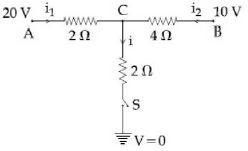
- 3When the switch $S$, in the circuit shown, is closed, then the value of current $i$ will be ................. $A$View Solution
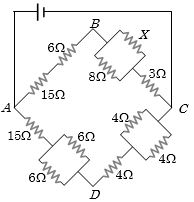
- 4In the figure given the value of $X$ resistance will be, when the $p.d.$ between $B$ and $D$ is zero ................... $ohm$View Solution
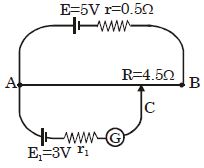
- 5In the given potentiometer circuit length of the wire $AB$ is $3\,m$ and resistance is $R = 4.5 \,\Omega.$ The length $AC$ for no deflection in galvanometer is ................ $\mathrm{m}$View Solution
- 6In a potentiometer experiment two cells of $e.m.f.$ $E_1$ and $E_2$ are used in series and in conjunction and the balancing length is found to be $58\, cm$ of the wire. If the polarity of $E_2$ is reversed, then the balancing length becomes $29\, cm$. The ratio $\frac{{{E_1}}}{{{E_2}}}$ of the $e.m.f.$ of the two cells isView Solution
- 7If resistance of the filament increases with temperature, what will be power dissipated in a $220\, V- 100\, W$ lamp when connected to $110\, V$ power supplyView Solution
- 8A cylindrical wire of radius $0.5 \,mm$ and conductivity $5 \times 10^{7}\, S / m$ is subjected to an electric field of $10 \,mV / m .$ The expected value of current in the wire will be $x ^{3} \,\pi mA$. The value of $x$ is ......View Solution
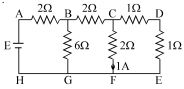
- 9The figure shows a network of resistors and $a$ battery. If $1\,A$ current flowsthrough the branch $CF$, then answer the following questions The current throughView Solution
- 10The resistance of a coil is $4.2\, \Omega$ at $100\,^o C$ and the temperature coefficient of resistance of its material is $ 0.004\,^o C$. Its resistance at $0\,^o C$ is ............. $\Omega$View Solution