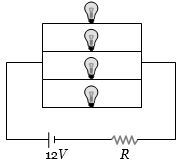
If resistance of the filament increases with temperature, what will be power dissipated in a $220\, V- 100\, W$ lamp when connected to $110\, V$ power supply
Easy


Download our appand get started for free
Experience the future of education. Simply download our apps or reach out to us for more information. Let's shape the future of learning together!No signup needed.*
Similar Questions
- 1The current in a conductor is expressed as $I=3 t^2+4 t^3$, where $I$ is in Ampere and $t$ is in second. The amount of electric charge that flows through a section of the conductor during $t=1$ s to $t=2 \mathrm{~s}$ is_______ C.View Solution
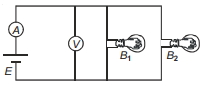
- 2Two identical bulbs are connected in parallel across an ideal source of emf $E$. The ammeter $A$ and voltmeter $V$ are ideal. If bulb $B_2$ gets fused, thenView Solution
- 3Two cells of $e.m.f.$ $E_1$ and $E_2$ are joined in series and the balancing length of the potentiometer wire is $625$ $cm$. If the terminals of $E_1$ are reversed, the balancing length obtained is $125 \,cm$. Given $E_2 > E_1$, the ratio $E_1: E_2$ will beView Solution
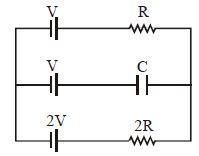
- 4View SolutionIn the given circuit, with steady current, the potential drop across the capacitor must be
- 5A current of $1\, mA$ is flowing through a copper wire. How many electrons will pass a given point in one secondView Solution
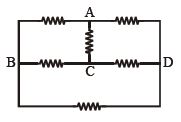
- 6View SolutionIn the following circuit composed of identical resistors, across which terminals would you connect a battery in order to dissipate energy in all resistors
- 7$62.5 \times {10^{18}}$ electrons per second are flowing through a wire of area of cross-section $0.1\,{m^2}$, the value of current flowing will be ............ $A$View Solution
- 8The ammeter reading in the circuit below is .............. $A$View Solution
- 9A square shaped wire with resistance of each side $3\, \Omega$ is bent to form a complete circle. The resistance between two diametrically opposite points of the circle in unit of $\Omega$ will be ......View Solution
- 10Four identical electrical lamps are labelled $1.5\,V$, $0.5\,A$ which describes the condition necessary for them to operate at normal brightness. A $12\,V$ battery of negligible internal resistance is connected to lamps as shown, thenView Solution