Question
If A and B are two events, then $\text{P}(\overline{\text{A}}\cap\text{B})=$
Answer

  1. $\text{P}(\text{B})-\text{P}(\text{A}\cap\text{B})$
Solution:

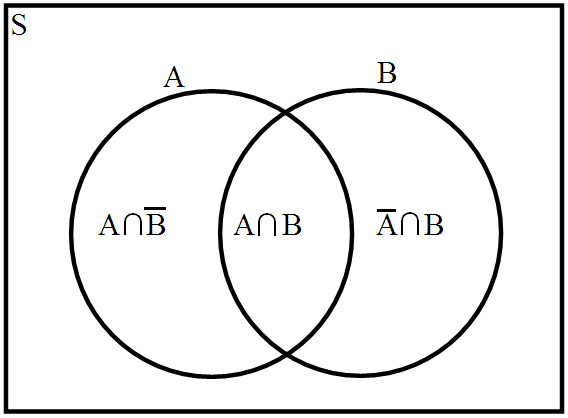
From the diagram, we get $\text{A}\cap\text{B}$ and $\overline{\text{A}}\cap\text{B}$ are mutually exclusive events such that $(\text{A}\cap\text{B})\cup(\overline{\text{A}}\cap\text{B})=\text{B}.$ therefore by
$\text{P}(\text{A}\cap\text{B})+\text{P}(\overline{\text{A}}\cap\text{B})=\text{P(B)}$
$\therefore\ \text{P}(\overline{\text{A}}\cap\text{B})=\text{P(B)}-\text{P}(\text{A}\cap\text{B})$

Need a full question paper?

Generate a complete, print-ready paper with questions like this in minutes — across 16+ boards, with answer keys.

Start Generating Free

Similar questions

If $\frac{\text{dy}}{\text{dx}}=\text{e}^{-2\text{y}}$ and y = 0, when x = 5, then the value of x when y = 3 is:
  1. $\text{e}^5$
  2. $\text{e}^5+1$
  3. $\frac{\text{e}^5+9}{2}$
  4. $\log_\text{e}6$
If $\overrightarrow{ a }+\overrightarrow{ b }=\hat{ i }$ and $\overrightarrow{ a }=2 \hat{ i }-2 \hat{ j }+2 \hat{ k }$, then $|\overrightarrow{ b }|$ equals:
A random variable has the following probability distribution:
$X = x_i$ $0$ $1$ $2$ $3$ $4$ $5$ $6$ $7$
$P(X = X_i)$ $0$ $2p$ $2p$ $3p$ $p^2$ $2p^2$ $7p^2$ $2p$
If $\vec{\text{a}}$ and $\vec{\text{b}}$ are unit vectors inclined at an angle $\theta,$ then the value of $\big|\vec{\text{a}}-\vec{\text{b}}\big|$ is:
  1.  $2\sin\frac{\theta}{2}$
  2. $2\sin\theta$
  3. $2\cos\frac{\theta}{2}$
  4. $2\cos\theta$
The probability that a leap year will have 53 fridays or 53 Saturdays is.
  1. $\frac{2}{7}$
  2. $\frac{3}{7}$
  3. $\frac{4}{7}$
  4. $\frac{1}{7}$
Consider the binary operation × on Q defind by a × b = a + 12b + ab for a, b ∈ Q. Find $2\times\frac{1}{3}$
  1. $\frac{20}{3}$
  2. 4
  3. 18
  4. $\frac{16}{3}$
Let $X_1$ and $X_2$ are optimal solutions of a $LPP,$ then:
A relation $\phi$ from C to R is defined by $\text{x }\phi\text{ y}\Leftrightarrow|\text{x}|=\text{y.}$ Which one is correct?
  1. $(2+3\text{i})\phi13$
  2. $3\phi(-3)$
  3. $(1+\text{i})\phi2$
  4. $\text{i}\phi1$
If the matrix AB is zero, then:
  1. It is not necessary that either A = 0 or, B = 0
  2. A = 0 or B = 0
  3. A = 0 and B = 0
  4. All the above statements are wrong
$\cos ^{-1}\left(\frac{1}{2}\right)+2 \sin ^{-1}\left(\frac{1}{2}\right)+4 \tan ^{-1}\left(\frac{1}{\sqrt{3}}\right)$ is equal to