MCQ
If a charged particle projected in a gravity-free room deflects:
- AThere must be an electric field.
- BThere must be a magnetic field.
- CBoth fields cannot be zero.
- DBoth fields can be non zero.
Explanation:
If a charged particle is projected in a gravity free room with some velocity, then its deflection depends on whether the particle experiences electric force or magnetic force. If electric field or magnetic field is absent in the space, then the charged particle will continue to move in the same direction with the same velocity. Thus, both electric and magnetic fields cannot be zero.
If force on the charged particle due to electric field is equal and opposite to the force due to magnetic field, then
$\text{F}=\text{qE}=\text{qvB}$
$\text{v}=\frac{\text{E}}{\text{B}}$
Thus, if anyone of the two fields is non zero, the charged particle will get deflect. Therefore, the correct option is (c) and (d).
Generate a complete, print-ready paper with questions like this in minutes — across 16+ boards, with answer keys.
Two magnets A and B are identical and these are arranged as shown in the figure. Their length is negligible in comparison to the separation between them. A magnetic needle is placed between the magnets at point P which gets deflected through an angle θ under the influence of magnets. The ratio of distance  and
and  will be
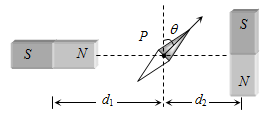
|
(a) |
(b) |
(c) |
(d) |
A star moves away from earth at speed 0.8 c while emitting light of frequency 6  . What frequency will be observed on the earth (in units of 1014 Hz) (c = speed of light)
|
(a) 0.24 |
(b) 1.2 |
(c) 30 |
(d) 3.3 |
The radio waves of frequency 300 MHz to 3000 MHz belong to
|
(a) High frequency band |
(b) Very high frequency band |
|
(c) Ultra high frequency band |
(d) Super high frequency band |
The wavelength of light emitted from second orbit to first orbits in a hydrogen atom is
|
(a) 1.215 |
(b) 1.215 |
(c) 1.215 |
(d) 1.215 |
Assertion : The temperature coefficient of resistance is positive for metals and negative for P-type semiconductor.
Reason : The effective charge carriers in metals are negatively charged whereas in P-type semiconductor they are positively charged.
|
(a) If both assertion and reason are true and the reason is the correct explanation of the assertion. |
|
(b) If both assertion and reason are true but reason is not the correct explanation of the assertion. |
|
(c) If assertion is true but reason is false. |
|
(d) If the assertion and reason both are false. |


