Question
If a current is passed in a spring, it(a) Gets compressed(b) Gets expanded(c) Oscillates(d) Remains unchanged
       

Answer

(a) Gets compressed

Need a full question paper?

Generate a complete, print-ready paper with questions like this in minutes — across 16+ boards, with answer keys.
Start Generating Free

Similar questions

In Young’s double slit experiment, the central bright fringe can be identified(a) By using white light instead of monochromatic light(b) As it is narrower than other bright fringes(c) As it is wider than other bright fringes (d) As it has a greater intensity than the other bright fringes


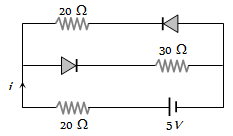
Current in the circuit will be
If a torch is used in place of monochromatic light in Young’s experiment what will happens(a) Fringe will appear for a moment then it will disappear(b) Fringes will occur as from monochromatic light(c) Only bright fringes will appear (d) No fringes will appear


For a given triode μ = 20. The load resistance is 1.5 times the anode resistance. The maximum gain will be(a) 16(b) 12(c) 10       (d) None of the above
       
One plate of parallel plate capacitor is smaller than other, then charge on smaller plate will be(a) Less than other(b) More than other(c) Equal to other(d) Will depend upon the medium between them


Specific resistance of a semiconductor on increasing temperature :
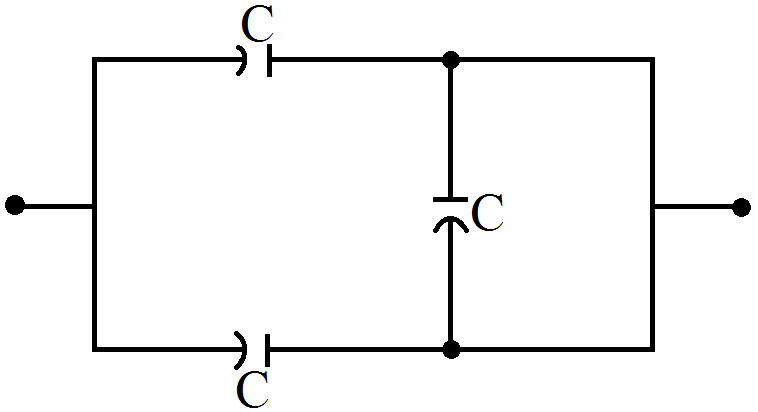
The equivalent capacitance of the combination shown in figure is:
The parallel rays of white light are made an incident normally on an air film of uniform thickness. 250 fringes are seen in the transmitted light between 4000$\mathring{\text{A}}$ and 6500$\mathring{\text{A}}$. Thickness of air film is:
Which of the following is electromagnetic wave ?
Photoelectric effect supports quantum nature of light because:
  1. There is a minimum frequency below which no photoelectrons are emitted.
  2. The maximum kinetic energy of photoelectrons depends only on the frequency of light and not on its intensity.
  3. Even when the metal surface is faintly illuminated the photoelectrons leave the surface immediately.
  4. Electric charge of the photoelectrons is quantized.