MCQ
If $A = \left[ {\begin{array}{*{20}{c}}3&{ - 5}\\{ - 4}&2\end{array}} \right],$then ${A^2} - 5A = $
  • A
    $I$
  • $14\ I$
  • C
    $0$
  • D
    None of these

Answer

Correct option: B.
$14\ I$
b
(b) ${A^2} = A.A = \left[ {\begin{array}{*{20}{c}}3&{ - 5}\\{ - 4}&2\end{array}} \right]{\rm{ }}\left[ {\begin{array}{*{20}{c}}3&{ - 5}\\{ - 4}&2\end{array}} \right]$

$ \Rightarrow \,{A^2} = \left[ {\begin{array}{*{20}{c}}{29}&{ - 25}\\{ - 20}&{24}\end{array}} \right]$ and $5A = \left[ {\begin{array}{*{20}{c}}{15}&{ - 25}\\{ - 20}&{10}\end{array}} \right]$

$\therefore$ ${A^2} - 5A = 14\left[ {\begin{array}{*{20}{c}}1&0\\0&1\end{array}} \right] = 14I$.

Need a full question paper?

Generate a complete, print-ready paper with questions like this in minutes — across 16+ boards, with answer keys.

Start Generating Free

Similar questions

${d \over {dx}}\left[ {\log \sqrt {{{1 - \cos x} \over {1 + \cos x}}} } \right] = $
The value of the function $(x - 1){(x - 2)^2}$ at its maxima is
Which of the following differentials equation has y = x as one of its particular solution?
  1. $\frac{\text{d}^{2}\text{y}}{\text{dx}^{2}}-\text{x}^{2}\frac{\text{dy}}{\text{dx}}+\text{xy}=\text{x}$
  2. $\frac{\text{d}^{2}\text{y}}{\text{dx}^{2}}+\text{x}^{2}\frac{\text{dy}}{\text{dx}}+\text{xy}=\text{x}$
  3. $\frac{\text{d}^{2}\text{y}}{\text{dx}^{2}}-\text{x}^{2}\frac{\text{dy}}{\text{dx}}+\text{xy}=\text{0}$
  4. $\frac{\text{d}^{2}\text{y}}{\text{dx}^{2}}+\text{x}^{2}\frac{\text{dy}}{\text{dx}}+\text{xy}=\text{0}$
The number of solutions of the system of inequations $x+2 y \leq 3,3 x+4 y \geq 12, x \geq 0, y \geq 1$ is
Let $\vec{a}=-5 \hat{i}+\hat{j}-3 \hat{k}, \vec{b}=\hat{i}+2 \hat{j}-4 \hat{k}$ and $\vec{c}=(((\vec{a} \times \vec{b}) \times \hat{i}) \times \hat{i}) \times \hat{i}$. Then $\vec{c} \cdot(-\hat{i}+\hat{j}+\hat{k})$ is equal to
Let $a, b$ and $c$ be three real numbers satisfying

$\left[\begin{array}{lll}a & b & c\end{array}\right]\left[\begin{array}{lll}1 & 9 & 7 \\ 8 & 2 & 7 \\ 7 & 3 & 7\end{array}\right]=\left[\begin{array}{lll}0 & 0 & 0\end{array}\right]$................$(E)$

$1.$ If the point $P(a, b, c)$, with reference to $( E )$, lies on the plane $2 x+y+z=1$, then the value of $7 a+b+c$ is

$(A)$ $0$ $(B)$ $12$ $(C)$ $7$ $(D)$ $6$

$2.$ Let $\omega$ be a solution of $x^3-1=0$ with $\operatorname{Im}(\omega)>0$. If $a=2$ with $b$ and $c$ satisfying $( E )$, then the value of $\frac{3}{\omega^a}+\frac{1}{\omega^b}+\frac{3}{\omega^c}$ is equal to

$(A)$ $-2$ $(B)$ $2$ $(C)$ $3$ $(D)$ $-3$

$3.$ Let $b=6$, with $a$ and $c$ satisfying (E). If $\alpha$ and $\beta$ are the roots of the quadratic equation $a x^2+b x+c=0$, then

$\sum_{n=0}^{\infty}\left(\frac{1}{\alpha}+\frac{1}{\beta}\right)^n$ is

$(A)$ $6$ $(B)$ $7$ $(C)$ $\frac{6}{7}$ $(D)$ $\infty$

Give the answer question $1,2$ and $3.$
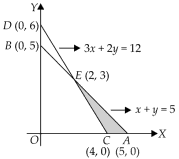
The maximum value of $Z=5 x+3 y$, if the shaded region represents the feasible region, is
Image
Let $x_{0}$ be the point of local maxima of $f(x)=\vec{a} \cdot(\vec{b} \times \vec{c}),$ where $\vec{a}=x \hat{i}-2 \hat{j}+3 \hat{k}$ $\overrightarrow{ b }=-2 \hat{ i }+ x \hat{ j }-\hat{ k }$ and $\overrightarrow{ c }=7 \hat{ i }-2 \hat{ j }+ x \hat{ k } \cdot$ Then the value of $\vec{a} \cdot \vec{b}+\vec{b} \cdot \vec{c}+\vec{c} \cdot \vec{a}$ at $x=x_{0}$ is 
If $A=\left[\begin{array}{cc}\sin ^2 \theta & \sec ^2 \theta \\ \operatorname{cosec}^2 \theta & \frac{1}{2}\end{array}\right]$ and $B=\left[\begin{array}{cc}\cos ^2 \theta & -\tan ^2 \theta \\ -\cot ^2 \theta & \frac{1}{2}\end{array}\right]$ the value of $A + B$ will be :
The direction ratios of the line $x - y + z - 5 = $$0 = x - 3y - 6$ are