MCQ
If a particle is moving on a circular path with constant speed, then the angle between the direction of acceleration and its position vector w.r.t. centre of circle will be ............ 
  • $\pi$
  • B
    $\frac{\pi}{2}$
  • C
    Zero
  • D
    $2 \pi$

Answer

Correct option: A.
$\pi$
a
(a)

Direction of Velocity is tangential to the circular path at any instance. At the very same instance, acceleration is along the radius, directed towards centre. So the angle between the direction of acceleration and its position vector with respect to the centre of the circle will be $\pi$ or $180^{\circ}$.

Need a full question paper?

Generate a complete, print-ready paper with questions like this in minutes — across 16+ boards, with answer keys.
Start Generating Free

Similar questions

A particle of mass $m$ moving eastward with a speed $v$ collides with another particle of the same mass moving northward with the same speed $v$. The two particles coalesce on collision. The new particle of mass $2m$ will move in the north-easterly direction with a velocity
A body of mass $m=3.513 \;kg$ is moving along the $x$ - axis with a speed of $5.00 \;ms ^{-1}$. The magnitude of its momentum is recorded as  (Consider significant figures)
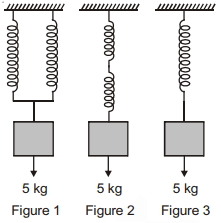
Two identical springs have the same force constant $73.5 \,Nm ^{-1}$. The elongation produced in each spring in three cases shown in Figure-$1$, Figure-$2$ and Figure-$3$ are $\left(g=9.8 \,ms ^{-2}\right)$
During the motion of a lift, apparent weight of a body becomes twice its actual weight when,
A beaker of height $H$ is made up of a material whose coefficient of linear thermal expansion is $3\alpha $ . It is filled up to the brim by a liquid whose coefficient of thermal expansion is $\alpha $. If now the beaker along with its contents is uniformly heated through a small temperature $T$ the level of liquid will reduce by (given $\alpha  << 1$) 
The moment of inertia of a body comes into play:
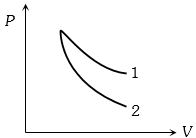
$P-V$ plots for two gases during adiabatic process are shown in the figure. Plots $1$ and $2$ should correspond respectively to
What is the intensity of gravitational field of the centre of a spherical shell
A body of moment of inertia of $3\ kg - {m^2}$ rotating with an angular speed of $2\ rad/sec$ has the same kinetic energy as a mass of $12\ kg$ moving with a speed of ......... $m/s$.
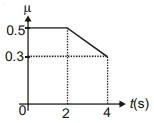
A block is projected with speed $20 \,m / s$ on a rough horizontal surface. The coefficient of friction $(\mu)$ between the surfaces varies with time $(t)$ as shown in figure. The speed of body at the end of $4$ second will be ............ $m / s$ ( $g=$ $10 \,m / s ^2$ )