MCQ
If a propagating wave meets a boundary which is not completely rigid or is an interface between two different elastic media, then which of the statements is/ are correct?
  • A
    A part of the incident wave is reflected and a part is transmitted into the second medium.
  • B
    The incident wave is completely reflected from the boundary.
  • C
    Only part of the wave is reflected and the remaining part disappears art disappears.
  • D
    None of the above.

Answer

  1. A part of the incident wave is reflected and a part is transmitted into the second medium.

Need a full question paper?

Generate a complete, print-ready paper with questions like this in minutes — across 16+ boards, with answer keys.

Start Generating Free

Similar questions

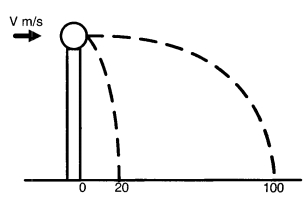
A ball of mass $0.2 \ kg$ rests on a vertical post of height $5 m$. A bullet of mass $0.01 \ kg$, traveling with a velocity $V / s$ in a horizontal direction, hits the centre of the ball. After the collision, the ball and bullet travel independently. The ball hits the ground at a distance of $20 \ m$ and the bullet at a distance of $100 \ m$ from the foot of the post. The initial velocity $V$ of the bullet is
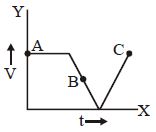
The velocity time graph of a body is shown in Figure. It implies that at point $B$ :-
$200\,g$ water is heated from $40\,^oC$ to $60\,^oC.$ Ignoring the slight expansion of water, the change in its internal energy is close to ...... $kJ$ (Given specific heat of water $=4184\,J/kgK$ )
A faulty thermometer has its lower fixed point marked as $ - \,10^\circ C$ and upper fixed point marked as $110^o $ and upper fixed point marked as $110^o $. If the temperature of the body shown in this scale is $62^o $, the temperature shown on the Celsius scale is ........ $^oC$
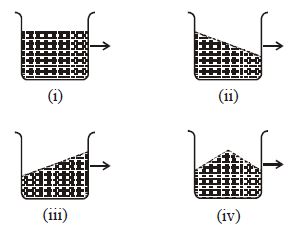
A vessel containing water is moving with a constant speed towards right along a straight horizontal path. Which of the following diagrams represents the surface of liquid?
Following statements are given for a stationary wave

$(a)$ Every particle has a fixed amplitude which is different from the amplitude of its nearest particle.

$(b)$ All the particles cross their mean position at the same time.

$(c)$ All the particles are oscillating with same amplitude.

$(d)$ There is no net transfer of energy across any plane.

$(e)$ There are some particles which are always at rest.

Which of the following is correct

A cord is used to lower vertically a block of mass $M$ by a distance $d$ with constant downward acceleration $\frac{g}{4}$. Work done by the cord on the block is
A particle is projected vertically upwards with a speed of $16\  m/s$ , after some time , when it again passes through the point of projection, its speed is found to be $8\  m/s$ . It is known that the work done by air resistance is same during upward and downward motion. Then the maximum height attained by the particle is ...................... $\mathrm{m}$ ( $g$ = $10\  m/s^2$ )
Which of the following measurements is most precise?
$Assertion :$ Air quickly leaking out of a balloon becomes cooler.
$Reason :$ The leaking air undergoes adiabatic expansion.